Free shipping from 100,-
100 day return period
Price Incl Vat

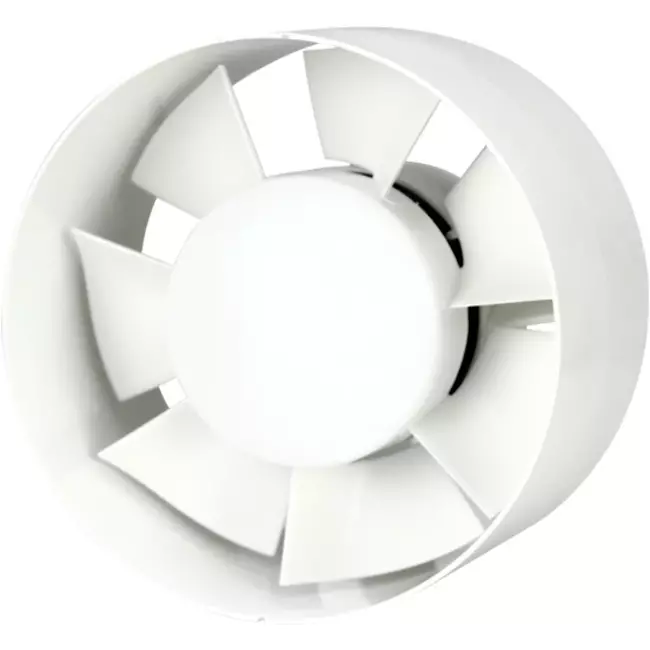
Plastic Duct Fan, Ø125 mm - EK125

Plastic Duct Fan, Ø125 mm - EK125
-35%
RRP 36.05
23.44 -35%
You'll save 12.61
  • In stock
  • The largest collection in the United Kingdom
  • 100 day return period
  • Customer review 9/10
  • Safe shopping with Trustedshops

Pay safe and fast with:

  • Creditcard
  • PayPal
  • Apple Pay

Plastic Duct Fan Ø125 mm - EK125

The EK125 is a plastic duct fan from Europlast with a diameter of 125 mm, designed for ventilating bathrooms, toilets, and other rooms within the home. You install the fan directly into the ventilation duct, where it extracts air and expels it outside through the connected ducting. The fan can be easily connected to a plastic ventilation duct, spiral duct, or flexible ventilation hose of 125 mm.


Benefits and Features

  • Powerful extraction – with an air displacement of 150 m³/h, the EK125 provides effective air removal in spaces such as bathrooms.
  • Quiet operation – at a noise level of 36 dB(A) measured at 3 metres, the fan is barely noticeable during use.
  • Moisture resistant – thanks to its IPX4 rating, the fan is protected against splashing water, making it suitable for humid environments.
  • Lightweight – the plastic housing weighs only 0.37 kg, simplifying installation.

Quiet and Efficient in Practice

The EK125’s motor runs at 16 watts and 2360 revolutions per minute, moving 150 m³ of air per hour. This is sufficient for rapid and noticeable air renewal in an average-sized bathroom or room of similar dimensions. With a noise level of only 36 dB(A), the fan is hardly audible during operation, even in a quiet residential setting. The fan operates reliably in ambient temperatures between +5°C and +40°C.


Installation, Maintenance and Applications

You install the EK125 within the ventilation duct and connect it to the electrical supply. This should always be performed by a certified electrician, and the power to the relevant circuit must be switched off beforehand. When connecting, remove the cover cap to access the terminal block, then connect the fan following the wiring diagram with the correct polarity. The EK125 is also available in versions with a timer and/or ball bearings, allowing the fan to continue operating for an adjustable period of 0 to 30 minutes after being switched off. Thanks to its plastic housing, the fan is lightweight, which facilitates installation.

Brand Europlast
Category Plastic Inline extractor fans
GTIN 4750492006580
Manufacturer's item number EK125
Article number 19300202

Specifications

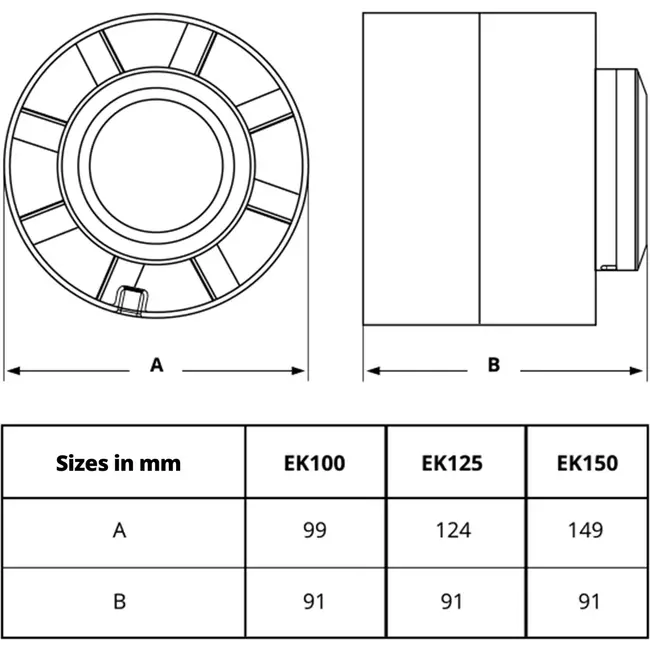
Connection diameter 125 mm
Category code 15
Max. Air Volume 150 m³/h
With timer No
Nominal frequency 50 Hz
Rated Speed 2360 1/min
Nominal power consumption 16 W
Nominal voltage 230 V

Reviews

Blogs

See all blogs
How do you install an inline tube fan?
A musty bathroom, a kitchen full of cooking fumes or a room where the air just doesn’t seem to circulate properly: these are all situations where you long for fresh air. An inline tube fan is often the ideal solution, especially when air needs to travel over a longer distance or overcome greater resistance in the ventilation system. But how do you install, mount and connect an inline tube fan correctly? In this blog, we explain exactly what you need to know: from choosing the right position in the duct to ensuring a safe and future-proof connection.
  • Felix Dijkmeijer
  • 12-08-2026
Tips to reduce your energy bills with good ventilation
Energy prices are skyrocketing, and decesion have to be made between eating or heating. It is time to make our homes more sustainable and thus save energy. In summer, our homes use less energy than in winter. In summer you are outside more often and the heating does not have to be switched on. In winter, we often keep the windows closed to keep the heat in, but unfortunately that is when the problems arise. There is no fresh air coming into our well insulated houses. The lack of fresh air leads to high CO2 levels, which in turn leads to various health complaints.
  • Felix Dijkmeijer
  • 30-09-2022
Ventilation duct selection guide
When you want to install a new ventilation system or renovate a ventilation system, you will have to choose from various ventilation pipes. With so many different ventilation pipes on the market, we understand that this choice can be quite overwhelming. For this reason we have developed a selection guide for you, in which you can find all the advantages and disadvantages of the ventilation pipes.
  • Felix Dijkmeijer
  • 08-04-2021