
-39%
-
In stock
Recommended price
238.40
-39%
145.43
Item number: 19500095


Bathroom extractor fans aren't something you replace every year, so it's nice to choose the right one first time. With good extraction, your bathroom dries quickly after a shower, the grout and ceiling stay free of mould, and you'll hardly notice the noise of the ventilation, if at all. Choose a fan that is too weak or doesn't suit your ducting, and the moisture will linger and the fan won't do much good. In this blog you'll find out, among other things, why ventilation is so important in the bathroom, which type of fan suits your situation, how to calculate the capacity you need, which controls are useful, where to install the fan safely and what to look out for when fitting it.
The key points from this blog at a glance:
A hot shower or a bath puts a lot of water vapour into the air. Warm air can hold a lot of water vapour, cold air much less. When the warm, moist air comes into contact with a cold surface, such as a mirror, the tiles or the ceiling, the air right next to that surface cools down. The cooled air can no longer hold all the moisture. The moisture that is left over settles on the surface as droplets. This is what we call condensation. Bathroom extractor fans remove the moist air before condensation can form.
Not sure whether your bathroom is ventilated well enough? Look out for the four signs below:
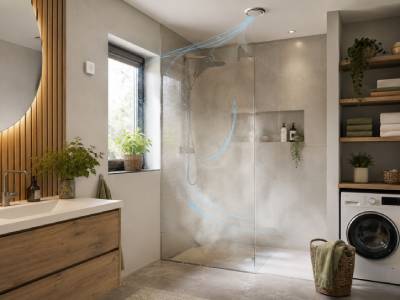
A steamed-up mirror
Is the mirror still steamed up 20 minutes after your shower? Then the water vapour is being removed too slowly.
Droplets and dark patches
Droplets run down the walls, there are dark patches on the ceiling or the plaster is coming loose.
Silverfish
Silverfish and other insects feel at home in a damp bathroom. If you see them (too) often, it's too damp in there.
A musty smell
Does the bathroom still smell musty and damp hours after a shower? Then the moist air is lingering in the room.

If you recognise one or more of these signs, don't wait too long. The biggest risk is mould. Besides black mould, green, blue or white patches of mould can also appear. Mould isn't just unsightly: the spores it spreads can irritate your airways.
The pink film you sometimes see in the shower isn't mould but a bacterium, which, just like mould, thrives in a damp bathroom. On top of that, the moisture from condensation soaks into the walls and ceiling. Over time, the plaster comes loose, the wood of window frames and doors can start to rot and bathroom furniture warps.
In the long run, poor bathroom ventilation is not only bad for your health, it also costs you (more) money.
To prevent mould and damp damage, the moist air needs to get outside as quickly as possible. Which fan works best for that depends mainly on the route the air takes from the bathroom to the outside. Bathroom extractor fans have a compact motor that moves a lot of air as long as that route is short. If the air has to travel through a long duct, you need a fan that builds up more force (pressure), such as one of our inline extractor fans.
Route up to about 1.5 metres
Choose a bathroom extractor fan
Bathroom extractor fans are fitted in the wall or ceiling of the bathroom. This type is a good fit if, for example:
Route longer than 1.5 metres
Choose an inline extractor fan
If the air has to travel through a long duct to the outside or the roof, a bathroom extractor fan isn't powerful enough. In that case, choose:
The 1.5 metres is a rule of thumb. Always consider the resistance and the capacity as well, as explained below.
Besides the length of the route, two other things play a big role. The first is resistance. Every metre of ventilation duct, every bend, a flexible hose and the grille at the end slow down the airflow. This resistance is expressed in pascals (Pa). The capacity stated for a fan is usually measured without any ducting attached. The more resistance there is in the duct, the less air the fan actually extracts in practice. The second is the capacity your bathroom needs: a large bathroom requires a more powerful fan than a small one. You can read how to calculate this capacity further on in this blog.
Do you already have a central ventilation system?
Does your bathroom already have an extract point connected to a central system, such as mechanical ventilation or one of our MVHR units? If so, do not fit an extra fan in the bathroom or in the ventilation ducts. An extra fan extracts additional air in an uncontrolled way. This creates negative pressure in your home, increases your energy consumption and makes the ventilation system work less well.
Would you still like your own bathroom extractor fan alongside mechanical extract ventilation? Then that bathroom extractor fan has to take over all the extraction for the bathroom, and you cap off the extract point of the mechanical ventilation in the bathroom completely. Never do this with an MVHR unit: it would upset the balance between the air coming in and the air going out.
The amount of air your bathroom extractor fan needs to remove per hour is expressed in cubic metres per hour (m³/h). In England, the Building Regulations (Approved Document F) require an intermittent bathroom extractor fan to extract at least 15 litres per second, which is 54 m³/h. With that minimum capacity, it often takes a long time in an average bathroom before the mirror and tiles are dry again. That's why we use this formula:
Length x width x height x 6 = capacity needed in m³/h
For example: your bathroom is 3 metres long, 2 metres wide and 2.5 metres high. The volume of the bathroom is then 3 x 2 x 2.5 = 15 m³. Multiply that by 6 and you need a bathroom extractor fan of 90 m³/h.
The number 6 stands for the number of times per hour that all the air in the bathroom is replaced. At 6 times per hour, the air in the bathroom is completely refreshed every 10 minutes. That gives you three benefits:
Good to know: a bathroom extractor fan can have around 20 to 30% more capacity than the result of the formula. In the example above, a bathroom extractor fan of 90 to about 117 m³/h is therefore suitable. That's handy, because you won't always find a model with exactly the calculated capacity. What's more, a bathroom extractor fan with a little extra capacity doesn't have to run at full power, so it's quieter and lasts longer.
Work it out for your own bathroom below:
Calculate the capacity for your bathroom
Enter the dimensions of your bathroom in metres. You can use a full stop or a comma.
Capacity needed
– m³/h
Suitable bathroom extractor fan
– m³/h
Enter all three dimensions to see the capacity you need.
The result is a guideline for homes. Not sure about your situation, for example with a long extract duct or a bathroom with a toilet? Feel free to ask our customer service for advice.
Once you know which type of fan you need and how much capacity, you choose how the fan switches on and off. Most people opt for a bathroom extractor fan with a humidity sensor and an overrun timer. With that combination, the fan switches on automatically as soon as the air gets humid and keeps running long enough to dry the bathroom. Do you have a toilet in the bathroom, or would you rather not have to switch the fan on yourself at all? Then there are more options.
Overrun timer
A bathroom extractor fan with timer keeps running for a while after you've switched off the light.
Humidity sensor
Humidistat fans switch on automatically as soon as the humidity rises.
Odour sensor
An odour sensor makes the fan run faster as soon as there are unpleasant smells. Handy in a bathroom with a toilet.
Motion sensor
A bathroom extractor fan with motion sensor switches on as soon as someone enters the room. Ideal for the toilet.
A bathroom extractor fan is connected to the mains, and often also to the bathroom light switch. When you switch the light on, the fan switches on too. This is especially important for a bathroom extractor fan with only an overrun timer and no sensor: that kind of fan doesn't switch on by itself, only when the light is on. Would you like to be able to switch the fan on separately from the light, for example to ventilate a bit longer after a shower without leaving the light on? In some cases, a second switch can be installed so you can switch the fan on and off yourself. A bathroom extractor fan with a humidity sensor, odour sensor or motion sensor switches on automatically, even without a light switch.
Can you adjust the run-on time of the overrun timer or the humidity level at which the humidity sensor switches on? That depends on the bathroom extractor fan. On some models you set this with a small dial (potentiometer) on the circuit board, on others via an app. Many bathroom extractor fans, however, have a fixed factory setting, or a humidity sensor that adjusts itself to the humidity in your bathroom. Would you like to choose the run-on time or the switch-on point yourself? Then check the specifications of the bathroom extractor fan to see whether the timer and humidity sensor are adjustable.
With the type, the capacity and the controls, you've made the most important choices. These points make the difference between a good bathroom extractor fan and a really pleasant one:

In the bathroom, electricity and water come together, and that's a dangerous combination. That's why the wiring regulations (BS 7671) divide the bathroom into zones. For each zone, there are rules on how well an appliance must be protected against water. You can see this from the IP rating: the higher the number after IPX, the better the appliance can withstand water.
Zone 0
Inside the bath or shower tray itself
Requirement: at least IPX7 and 12 volts only
Fan: in practice, no fan is installed here
Zone 1
Directly above the bath or shower tray, up to 2.25 metres high
Requirement: at least IPX4
Fan: ideally one of our 12V bathroom extractor fans
Zone 2
Up to 60 cm beside the bath or shower, up to 2.25 metres high
Requirement: at least IPX4
Fan: a 230 V bathroom extractor fan with IPX4
Outside the zones
The rest of the bathroom and everything above 2.25 metres
Requirement: no additional IP requirement, but IPX4 is recommended
Fan: a 230 V bathroom extractor fan
Older guidance sometimes still mentions a zone 3. This zone no longer exists in the current BS 7671.
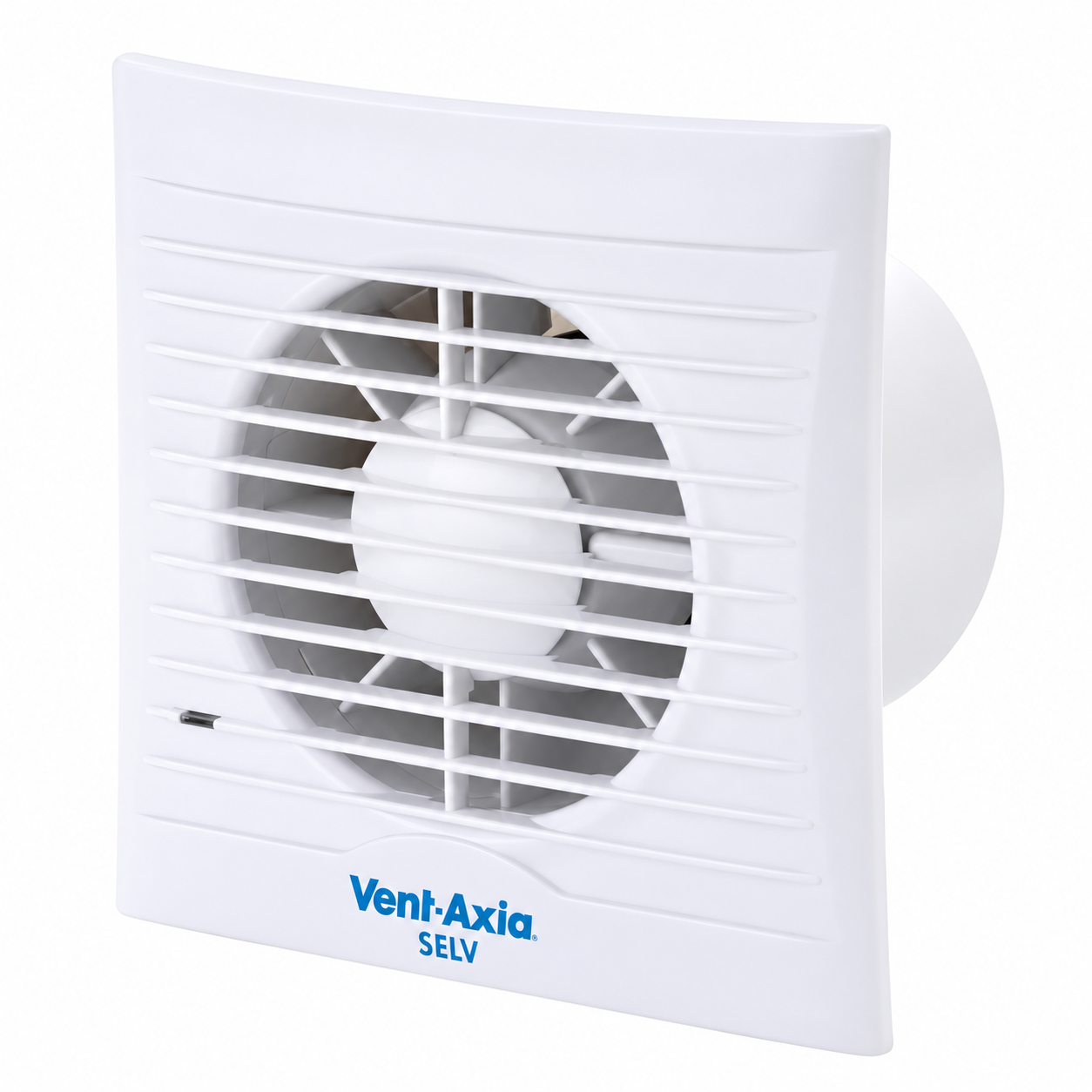
If you want to fit the fan directly above your shower or bath, choose a 12 volt bathroom extractor fan, such as the Vent-Axia Azur SELV bathroom fan. It runs on a safe extra-low voltage and is suitable for zone 1. In addition, all electrical circuits in the bathroom must be protected by a 30 mA RCD. If you're unsure about the connection, have the electrical work carried out by a qualified electrician.
These zones mainly apply to bathroom extractor fans that are fitted in the wall or ceiling of the bathroom itself. With an inline extractor fan, a pipe roof fan or a central ventilation system, the motor is outside the bathroom, for example in the loft or on the roof. In the bathroom you then only see a ventilation valve or grille. No electricity runs through it, so no zone requirements apply to that valve or grille. That makes an inline extractor fan a safe choice if you'd rather not have any 230 volt appliance near the shower at all. You can read more about the zones and IP ratings in our blog everything you need to know about bathroom ventilation.
Good installation largely determines how quietly your fan runs and how long it lasts. You can read how to tackle it step by step in our blogs on easily installing a bathroom fan yourself and how to install an inline tube fan. They explain, among other things, which ventilation duct to use and how to connect the fan airtight.
One thing many people forget: a fan can only extract air if air can also get into the bathroom. So make sure there's a gap of about 1 cm under the bathroom door or fit one of our air vent covers in the door. This lets air flow in from the rest of the home. That air is warmer than outside air, so the bathroom cools down less and less condensation forms.
Item number: 19500095
Item number: 19401040

Item number: 19402148

Item number: 19402064
Item number: 19402141

Item number: 19300313
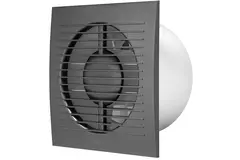
Item number: 19300171

Item number: 19300137
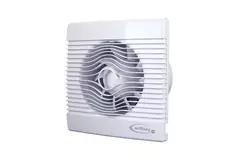
Item number: 19401013
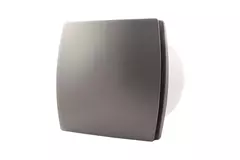
Item number: 19300033
Item number: 19500094

Item number: 19300121
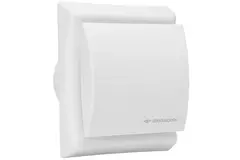
Item number: 19110500
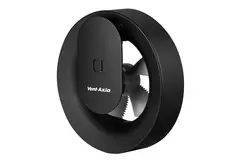
Item number: 19500010
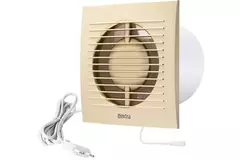
Item number: 19300165

Item number: 19300404
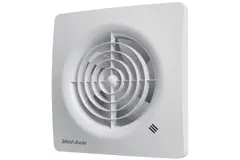
Item number: 19500092
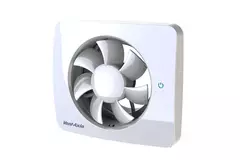
Item number: 19500020

Item number: 19300314
Item number: 19500016

Not sure which solution works best in your situation? Click here to get in touch with us. Our ventilation experts are always happy to help you choose the right bathroom ventilation: from the type of fan and the capacity you need to the ventilation ducts, grilles and other parts that go with it.
Handy to have to hand when you get in touch:
In this FAQ we answer the questions we're asked most often about choosing and using a bathroom extractor fan. Can't find your question, or would you like advice for your situation? Our experts are ready to help, so feel free to get in touch!
Usually 15 to 30 minutes is enough. A handy check: if the bathroom extractor fan is still running when the mirror and tiles are already dry, the overrun time is more than sufficient. A bathroom extractor fan with a humidity sensor takes care of this automatically, as it keeps running until the humidity has dropped again.
Yes, that's a common way to do it: the bathroom extractor fan switches on as soon as you switch on the light. If the bathroom extractor fan has an overrun timer, it needs a permanent live in addition to the switched live. Only then can the fan keep running after you've switched the light off. The manual of the bathroom extractor fan explains how to connect it.
An inline extractor fan isn't fitted in the bathroom itself, but in the extract duct in a dry place, for example in the loft. You fit the inline extractor fan between two lengths of ventilation duct, or slide an in-duct model into an existing duct. Only a valve or grille goes in the bathroom ceiling, and the duct runs outside via a roof vent. An inline extractor fan needs a fixed electrical connection, so it doesn't work with a plug. You can read how to do it step by step in our blog how do you install an inline tube fan?
An open window helps, but how much moist air gets out depends on the wind and the outside temperature. In winter, hardly anyone leaves the window open for long after a shower, because the bathroom cools down quickly. A bathroom extractor fan removes the moist air in every season, even when the window is closed.
A standard bathroom extractor fan isn't designed for that. It's meant to remove a lot of moist air quickly at peak moments, during and after a shower or bath. If you leave it running day and night, the motor wears out faster, especially in models with sleeve bearings, and the bathroom extractor fan won't last as long. It also removes warm air from your home all day long. So only let the bathroom extractor fan run when it's needed, for example with a humidity sensor or an overrun timer. If you still want continuous ventilation, choose a model that the specifications explicitly state is suitable for continuous running. A model like this runs on a low setting all day and switches to a higher setting when you shower.
Clean the front and the blades of the bathroom extractor fan at least once or twice a year. Dust and grease on the blades slow down the airflow and make the fan noisier. First switch off the power to the fan, for example at the consumer unit, and use a damp cloth or a soft brush.
At Ventilationland, we think it is important that we can always be reached and answer your questions as quickly as possible. Therefore, you can reach us in several ways, including via chat or WhatsApp. We are happy to help!