

What is demand-controlled ventilation?

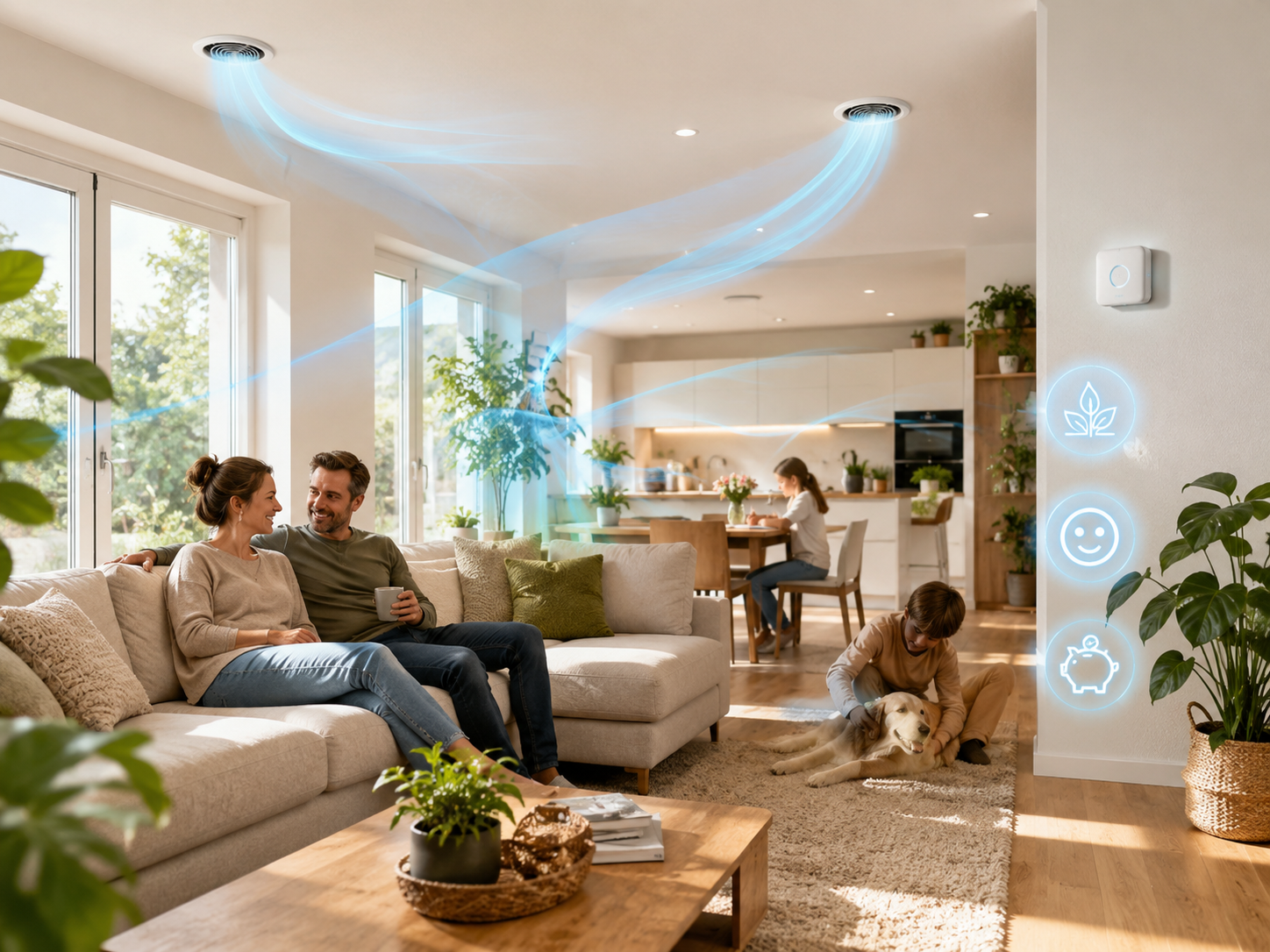
Demand-controlled ventilation automatically adjusts based on the air quality in your home. It ventilates more when needed and less when it isn't. The result: a healthy indoor climate and lower energy consumption, without any effort on your part. In 2026, demand-controlled ventilation is the standard in modern mechanical ventilation systems and heat recovery units. In this blog, you'll find everything you need to know about demand-controlled ventilation and which products from our range are suitable!
Why should I choose demand-controlled ventilation?
Homes have become increasingly well-insulated and airtight over the years. As a result, there is hardly any natural ventilation through gaps and seams anymore. At the same time, we generally spend more time indoors. This can lead to rising CO2 levels, increased moisture, mould, house dust mites and other problems caused by poorer air quality. In the past, ventilation was only used in the kitchen, bathroom or toilet. Today, ventilation plays a crucial role in maintaining a healthy indoor climate throughout the entire home. In a demand-controlled ventilation system — whether in an existing home or new build — the system adjusts automatically based on actual air quality, not on a timer or a fixed setting.
How does demand-controlled ventilation work exactly?
With demand-controlled ventilation, sensors continuously measure the air quality in each room. Think of CO2 concentration (measured in PPM, parts per million) and relative humidity (RH). The measured values are compared to preset target values. When these values are exceeded — for example because several people are in the living room — the system automatically increases ventilation to that room. This works via control valves located in the duct system or at the connection points per room. These valves have multiple positions and regulate how much air is let through or extracted per room. The ventilation system determines the required ventilation level automatically, based on the sensor readings.
In addition to CO2 and humidity sensors, there is a third type: the VOC sensor (also known as an odour sensor). This measures volatile organic compounds in the air — think of musty smells in the toilet or a bathroom with toilet. As soon as the sensor detects a rise in odour molecules, the system automatically switches to a higher ventilation level. Practical and discreet, without you having to touch a switch. Please note: not every ventilation system supports a VOC sensor. Always check the compatibility of your unit.
Demand-controlled ventilation with balanced ventilation (HRV system): supply and extract in balance
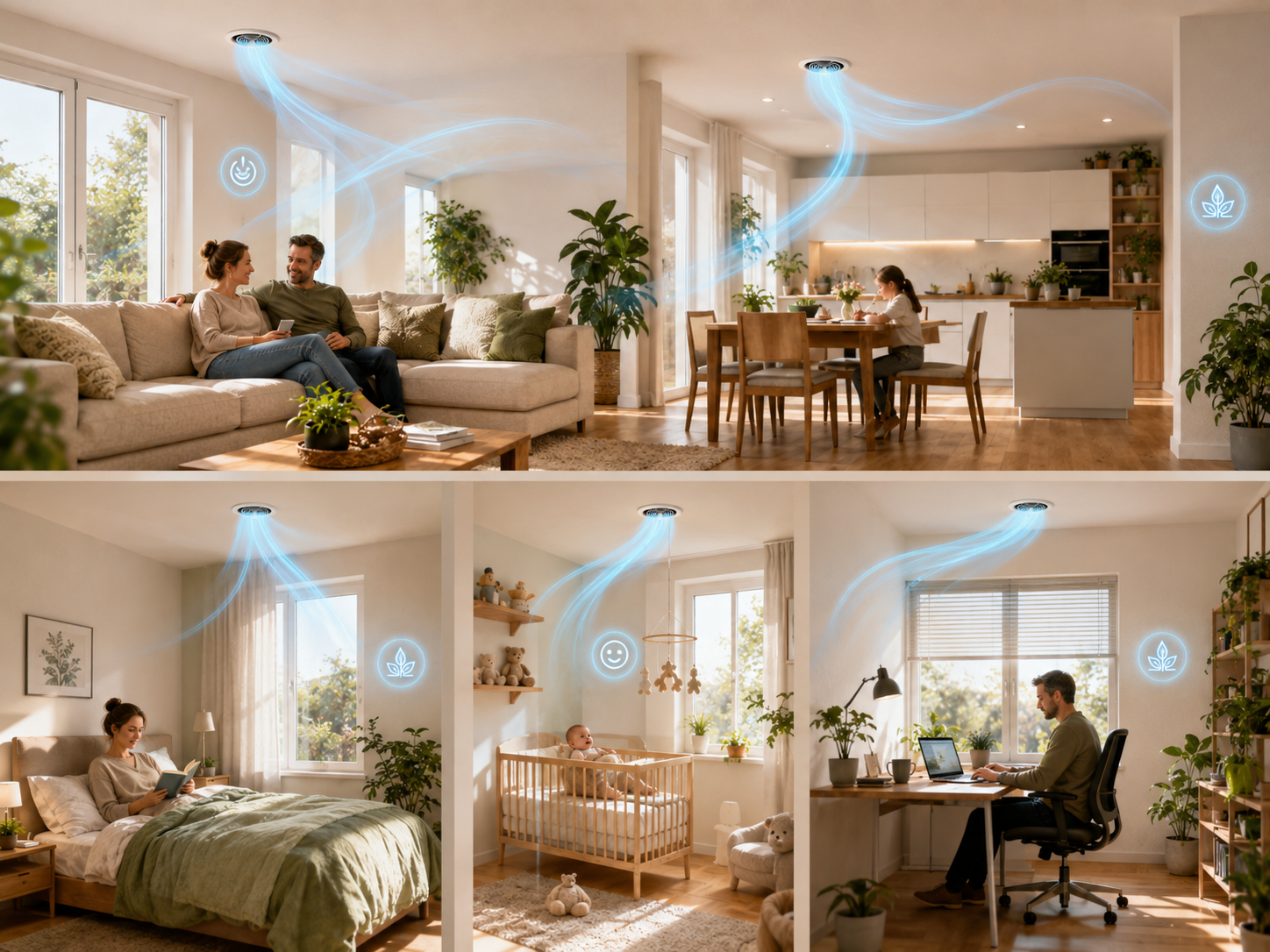
With a heat recovery unit (system D, balanced ventilation), it is important that the supply and extract of air are always balanced. If more fresh air is supplied to the living room, more must also be extracted — otherwise the system becomes unbalanced. This is solved by dividing the system into zones: a day zone (ground floor: living room, dining room) and a night zone (upper floor: bedrooms). Each zone has its own control valve that regulates both supply and extract per zone.
Demand-controlled mechanical ventilation (MV): demand-controlled extraction per room
With mechanical ventilation (system C), there is only extraction; fresh air enters through grilles. Here too, sensors can control the dampers per room. For example, the bathroom can ventilate extra when humidity is too high, while the rest of the home remains at a minimum setting. The control valve is located in the ventilation duct per room. Please note: not every control valve is compatible with every ventilation unit. Always check whether the sensors and control valves are suitable for your specific system.
How does demand-controlled ventilation work across different zones?
With a heat recovery system, you can refine ventilation further by dividing your home into zones — a day zone and a night zone. Based on CO2 measurements in, for example, the living room and bedroom, zone dampers on the supply ducts direct the ventilation air precisely where it is needed. Is the air quality in the living room poor but good in the bedroom? Then more air is directed to the living room, while the bedroom continues to ventilate at a minimum. This way, each room receives exactly the ventilation it needs — never too little and never too much. The result is lower energy consumption and a lower noise level.
With zoning sets that also include the extract side (such as QuattroZone by Itho Daalderop), not only the supply but also the extract is split into zones — think of a separate extract zone for the kitchen and wet rooms. View the differences between the various zoning solutions from Orcon, Duco, Itho Daalderop and Brink, or read more about it here.
Discover our demand-controlled heat recovery systems!
Demand-controlled ventilation is the standard in most modern heat recovery units in 2026. Below you will find some popular demand-controlled heat recovery units from our range. Click on the product name to view all available models and options directly.
- Orcon HealthLine HRC-400 series — Works seamlessly with CO2, humidity and presence sensors for fully automatic, demand-controlled ventilation.
- Brink Renovent (Excellent / Sky / Flair) — Expandable with the Brink CO2 control set for DuoZone demand-controlled ventilation; supports up to 8 CO2 sensors.
- Itho Daalderop HRU series — Available with DuoZone and QuattroZone control sets for targeted zone control.

Discover our demand-controlled mechanical ventilation units!
In the category of demand-controlled mechanical ventilation (system C), we also offer several suitable systems. Click on the product title below to view all available options and variants.
- DucoBox Silent 2.0 series — very quiet mechanical ventilation unit, connectable to CO2 and humidity sensors per room for demand-controlled ventilation.
- Vent-Axia MultiHome series — versatile mechanical ventilation unit, suitable for multiple rooms in the home. Can be expanded with a presence sensor.
- Itho Daalderop CVE-S ECO standard series — popular energy-efficient mechanical ventilation unit, suitable for demand-controlled expansion with humidity sensors.
Can I make my current ventilation unit demand-controlled?
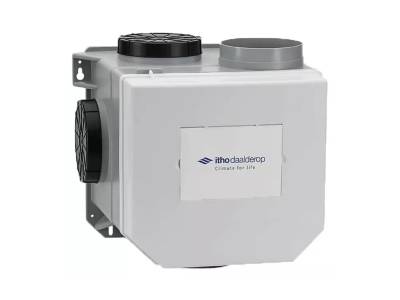
That depends on your current system. Do you still have a fully natural ventilation system (type A or B)? Then demand-controlled ventilation is not possible without a complete upgrade to system C or D. Do you already have a mechanical ventilation unit or heat recovery unit? Then expansion with sensors and/or control valves is possible in some cases, provided the unit is suitable for this. Not every model has the right connections or can process sensor data. For older units (more than approximately 15 years old), full replacement is almost always the better choice. Not sure whether your system is suitable? Our specialists are happy to help.
What are the benefits of demand-controlled ventilation?
- Healthy indoor climate, fully automatic
- Energy-saving: only ventilate what is needed
- Flexible: adjustable per room or per zone
- Quieter: lower airflow = lower noise level
- Low maintenance and easy to operate
- Suitable for both new builds and existing homes
Good to know about demand-controlled ventilation:
- A demand-controlled ventilation system is not disrupted when you open a window or door.
- Demand-controlled ventilation does not respond to odours. You will need to adjust this manually.
- A demand-controlled ventilation system requires periodic maintenance (approximately every 2 years).
- Not all sensors and control valves are universal: always check compatibility with your unit first.
In short: Demand-controlled ventilation is the smartest way to keep your home healthy and energy-efficient. Whether you choose a heat recovery system or a mechanical ventilation unit — demand-controlled is the standard in 2026.
Not sure which demand-controlled ventilation system suits your home best? Or do you have any other questions about demand-controlled ventilation after reading this blog? Get in touch with our specialists. You can reach us in several ways: via WhatsApp, chat, email or phone.
Can we help you with anything else?
At Ventilationland, we think it is important that we can always be reached and answer your questions as quickly as possible. Therefore, you can reach us in several ways, including via chat or WhatsApp. We are happy to help!