A well-insulated home with an MVHR unit gets fresh air all day long without losing its heat. Even so, the air indoors can feel dry in winter. That is because a standard MVHR unit recovers the heat from the extracted air, but not the moisture. An MVHR unit with an enthalpy exchanger does. So what is an enthalpy exchanger exactly? It is a heat exchanger that passes on water vapour as well as heat from the extracted air to the fresh supply air. This keeps the air less dry in winter, and in summer the enthalpy exchanger keeps part of the humid outdoor air outside. The result is a more comfortable indoor climate, without a humidifier and without using extra water.
In this blog, you'll read how the vapour-permeable membrane in an enthalpy exchanger works and how much moisture is recovered in practice. We work this out for you with an example in the Mollier diagram, a chart that engineers use to map the properties of humid air. You'll then find out what an enthalpy exchanger does for you in winter and summer, and how an enthalpy exchanger differs from a cross-flow heat exchanger and a humidifier. Finally, we list a number of MVHR units with an enthalpy exchanger.
The key points from this blog at a glance:
An enthalpy exchanger is a heat exchanger with a membrane that lets water vapour through, so the MVHR unit exchanges moisture as well as heat
The membrane does not store moisture: water vapour constantly moves from the more humid to the drier airflow
How much moisture passes through depends on the moisture content in grams per kilogram of air, the temperature and the type of membrane, not on an average of two percentages
The MVHR unit cannot set or control the humidity; moisture transfer is a passive process
In winter, less dry air enters your home; in summer, part of the humid outdoor air stays outside
A humidifier adds water to the air, whereas an enthalpy exchanger only recovers moisture that is already in the extracted air.
What is an enthalpy exchanger?
An MVHR unit extracts stale indoor air and brings in fresh outdoor air at the same time. At the heart of the MVHR unit is a heat exchanger, where the two airflows pass each other without mixing. In most MVHR units, this is a cross-flow or counterflow heat exchanger with plastic or aluminium walls. These walls let heat through, but not water vapour.
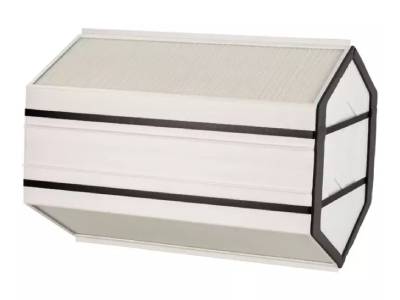
An enthalpy exchanger works on the same principle, except that the walls between the airflows are made of a membrane that lets water vapour through. As a result, the MVHR unit exchanges two things: heat and moisture. This is also what the word enthalpy refers to. Enthalpy is the total amount of energy in the air, meaning the heat you measure with a thermometer plus the energy contained in the water vapour.
Good to know: an enthalpy exchanger does not hold on to moisture or store it to release later. Water vapour passes through the membrane continuously, from the airflow with the highest moisture content to the airflow with the lowest. You can read below exactly how the membrane does this.
How does the vapour-permeable membrane work?
The membrane in an enthalpy exchanger is a thin film, usually made of a special polymer (a type of plastic). Some manufacturers use treated paper or cellulose. The secret lies in how the material interacts with water: water molecules dissolve into the membrane, move through it and come out on the other side. The air itself does not pass through the membrane, and larger molecules such as odours mostly don't either. Zehnder, for example, states that the polymer membrane in its ComfoAir Q units is designed to stop viruses, bacteria and certain gases from passing from the extract air to the supply air.
What drives the water vapour is the difference in vapour pressure between the two airflows. Put simply: the water vapour moves from the airflow with the most grams of water per kilogram of air to the airflow with the fewest. There is no pump, valve or sensor involved. This also means that the MVHR unit cannot set, control or keep the humidity in your home at a particular level. Moisture transfer is passive and depends on the conditions at that moment.
Water vapour passes through the membrane
Heat passes through the membrane
Air and odours are held back
Simplified diagram of an enthalpy exchanger in winter. The airflows pass each other without mixing.
How well a membrane lets water vapour through varies by manufacturer and type. Manufacturers have this measured under fixed test conditions and state it as the moisture recovery efficiency. For the Brink Flair 300 Enthalpy and the Zehnder ComfoAir Q350 with enthalpy exchanger, this is around 78% in winter, according to measurements by the Passive House Institute. That percentage does not mean that the humidity indoors will be 78%. It shows how much of the difference in moisture content between the two airflows the membrane transfers under test conditions. In your own home the result may be different, and that is exactly where the Mollier diagram comes in.
Why can't you simply calculate the moisture transfer?
A common assumption is: if the outdoor air comes in at 80% relative humidity (RH) and the indoor air goes out at 50% RH, the fresh air will enter the home at around 65% RH after passing through the enthalpy exchanger. That calculation is wrong. Relative humidity only tells you what percentage of the maximum amount of water vapour the air holds at that temperature. Cold air can hold far less water vapour than warm air.
Outdoor air at 0 °C and 80% RH contains about 3.0 grams of water per kilogram of air. Indoor air at 21 °C and 50% RH contains about 7.7 grams per kilogram, more than twice as much. So the outdoor air with the higher percentage is actually the drier air.
How does the Mollier diagram work?
To see all these factors at a glance, engineers use the Mollier diagram. This is a chart that shows the properties of humid air. In the UK, the psychrometric chart is more common: it shows the same information, but with the axes swapped. In the Mollier diagram, the horizontal axis shows the moisture content in g/kg and the vertical axis shows the temperature. The curved lines show the relative humidity, from 10% on the left to 100% at the bottom right. That bottom line is called the saturation line: once air reaches it, the air cannot hold any more water vapour and condensation forms. The diagonal dotted lines connect points with the same enthalpy, meaning the same total amount of energy in the air. Every state of the air is a single point in the Mollier diagram, and what an MVHR unit does to the air appears as a line between two points.
Worked example: a cold winter's day
In this example, it is 0 °C with 80% RH outside and 21 °C with 50% RH inside. The MVHR unit extracts as much air as it supplies, with a heat recovery efficiency of 85% and a moisture recovery efficiency of 70%. That moisture recovery efficiency is deliberately a little lower than the test value of 78%, because conditions in a home are rarely as favourable as in a test set-up. On the left you can see the calculation steps, on the right the same steps in the Mollier diagram.
Step 1: the temperature
The temperature difference between inside and outside is 21 degrees. The MVHR unit recovers 85% of this: 0.85 × 21 = 17.9 degrees. So the fresh outdoor air enters the home at 17.9 °C (points C and D).
Step 2: the moisture content
The difference in moisture content is 7.7 g/kg minus 3.0 g/kg, which is 4.7 g/kg. The membrane transfers 70% of this: 0.70 × 4.7 = 3.3 g/kg. With an enthalpy exchanger, the fresh air therefore goes from 3.0 to 6.3 g/kg (point C). With a cross-flow heat exchanger, it stays at 3.0 g/kg (point D).
Point
Air
Temperature
Moisture content
RH
A
Fresh outdoor air
0.0 °C
3.0 g/kg
80%
B
Extract air from the home
21.0 °C
7.7 g/kg
50%
C
Supply air after the enthalpy exchanger
17.9 °C
6.3 g/kg
50%
D
Supply air after a cross-flow heat exchanger
17.9 °C
3.0 g/kg
24%
E
Exhaust air to outside, after the enthalpy exchanger
3.2 °C
4.4 g/kg
93%
Simplified worked example with fixed efficiencies and equal airflow rates. In a real home, the temperature, moisture content and efficiencies change all the time, for example due to cooking, showering, the number of occupants and the ventilation setting.
What does this worked example show? With an enthalpy exchanger, the fresh air enters at 6.3 g/kg (point C), which works out at around 50% RH at 17.9 °C. Once the air in the home has warmed up to 21 °C, air with that moisture content still has around 41% RH. With a standard cross-flow heat exchanger, the moisture content of the fresh air stays at 3.0 g/kg (point D). At 21 °C, that is only around 20% RH: on the dry side, especially if you ventilate a lot in winter.
There is also something to see on the extract side. After the enthalpy exchanger, the exhaust air leaves at 3.2 °C and 4.4 g/kg (point E). That is just below the saturation line, so in this example no condensation forms in the MVHR unit. With a cross-flow heat exchanger, the cooled extract air keeps all of its moisture, 7.7 g/kg. At 3.2 °C, air cannot hold that much moisture, so some of it is left behind as condensate in the MVHR unit. That is why an MVHR unit with a cross-flow heat exchanger needs a condensate drain, and an MVHR unit with an enthalpy exchanger often does not.
What difference does it make in winter and summer?
The worked example shows that water vapour always moves towards the drier airflow. Which way that is depends on the season. As a result, an enthalpy exchanger helps to create a comfortable indoor climate all year round, in two different ways.
Winter: healthy humidity indoors
With a standard MVHR unit, the cold outdoor air enters the home after warming up with a relative humidity of around 20%. That is far too dry. The enthalpy exchanger passes part of the moisture from the extracted indoor air on to the fresh air. In the worked example, this brings the supply air to around 40% RH, within healthy limits. This prevents dry air in your home.
Summer: less muggy air indoors
On a muggy day of 28 °C and 60% RH, the outdoor air is more humid than the cooler air inside. The enthalpy exchanger now works the other way round: the humid outdoor air gives off part of its moisture to the drier extract air. As a result, the fresh air enters at around 56% RH, instead of around 73% with a standard MVHR unit. So much less muggy air is blown into your home.
On cool summer evenings and at night, many MVHR units open their summer bypass. The cool outdoor air then flows around the heat exchanger into the home, cooling it down. At that point, no heat or moisture is exchanged.
Do you have air conditioning at home? Then an MVHR unit with an enthalpy exchanger is a good combination, whether the air conditioning is cooling or heating. When cooling, less muggy outdoor air comes in after the enthalpy exchanger. The air conditioning therefore has to remove less moisture from the air, and the cooled air feels less stuffy.
Many modern air conditioning units can also heat. An air conditioner that heats makes the air warmer, but does not add any water vapour. The amount of water vapour in the air therefore stays the same, while the relative humidity drops. For example, air at 18 °C and 50% RH has only around 39% RH after being heated to 22 °C. Because the enthalpy exchanger returns part of the moisture from the extracted air to the fresh air, the air in your home dries out less quickly when you heat with your air conditioning. In the blog Combining air conditioning and ventilation: is it possible? you can read what to look out for if you have both systems at home.
How do you keep humidity within healthy limits?
Why does this moisture transfer actually matter? For a healthy and comfortable indoor climate, the relative humidity at home should ideally be between 40% and 60%. If the humidity drops below that or stays above it for a long time, you will notice it in your body and in your home. You can read more about measuring and improving humidity in our blog Humidity in your home: what it is and what you can do about it.
< 40%
Air that is too dry
Dry, irritated eyes, nose and throat
Tickly cough and chapped lips or dry skin
More static shocks
Wooden floors and furniture that shrink or crack.
> 60%
Air that is too humid
Condensation on windows and cold walls
Risk of mould in corners and behind cupboards
More dust mites, a problem for allergy sufferers
A stuffy, clammy feeling indoors.
An enthalpy exchanger helps to keep the humidity between 40% and 60% more often. In winter, the enthalpy exchanger prevents ventilation from causing the humidity to drop sharply, and in summer it slows down the supply of muggy air.
As you saw in the worked example, this is not precise control: the humidity shifts a little in the right direction, but the MVHR unit does not work towards a fixed value.
What is the difference from a cross-flow heat exchanger or humidifier?
An enthalpy exchanger is often confused with a humidifier, and the difference from a standard cross-flow heat exchanger is not immediately clear to everyone either. The main difference: an enthalpy exchanger recovers moisture that is already in the extracted indoor air, whereas a humidifier adds new moisture to the air.
A HomEvap MVHR air humidifier is installed in the supply duct, after the MVHR unit. The HomEvap air humidifier is connected to the water supply and evaporates water into the fresh air entering your home. This means you can raise the humidity even in a home that produces little moisture. To find out how evaporation affects the air, read our blog about adiabatic cooling.
MVHR with cross-flow heat exchanger
MVHR with enthalpy exchanger
HomEvap MVHR air humidifier
Recovers heat
Recovers moisture from the extract air
Adds new moisture to the air
Keeps muggy summer air partly outside
Works without a water connection
Works without a condensate drain
n/a
yes or usually yespartlyno
Indicative comparison; exact features vary by brand and model.
So an enthalpy exchanger and a humidifier are not mutually exclusive. If the air in your home is still too dry in winter despite an enthalpy exchanger, a HomEvap MVHR air humidifier can make the difference. If the air is only occasionally a little dry, an MVHR unit with an enthalpy exchanger is often enough, without using extra water or electricity.
Which MVHR unit with an enthalpy exchanger suits you?
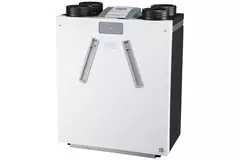
An MVHR unit with an enthalpy exchanger is particularly worthwhile if the air in your home often feels dry in winter, if you have a well-insulated home where the MVHR unit ventilates all year round, or if you use air conditioning in summer. At Ventilationland, you'll find MVHR units with an enthalpy exchanger from Brink, a well-known Dutch manufacturer of ventilation systems.
Brink
Brink Ease 200 Enthalpy
Compact MVHR unit up to 200 m³/h, suitable for flats and smaller homes.
Would you like to compare all the options? Take a look at our full range of MVHR units.
In short: an enthalpy exchanger turns an MVHR unit into a system that exchanges moisture as well as heat. You don't get a dial for the humidity, but you do get an indoor climate that stays within the healthy range of 40% to 60% humidity more often, all year round.
In the FAQ below, we've put together the most frequently asked questions about the enthalpy exchanger and the MVHR unit with an enthalpy exchanger. Do you have a question about your home, or are you unsure which MVHR unit is right for you? Feel free to contact our customer service team. Our experts will be happy to help.
The difference lies in the material of the walls between the airflows. In a cross-flow heat exchanger, these walls are impermeable to water vapour, so only heat is transferred. In an enthalpy exchanger, the walls are made of a vapour-permeable membrane, so part of the moisture also passes from one airflow to the other, as well as heat.
Manufacturers and test institutes measure, under fixed conditions, what proportion of the difference in moisture content (in grams of water per kilogram of air) between the extract air and the fresh air is transferred. This ratio is called the moisture recovery efficiency. To work out what that means in a home, an installer calculates with the temperature and moisture content of both airflows and plots the result in the Mollier diagram, as in the worked example in this blog.
You keep the heat recovery of a standard MVHR unit and gain moisture recovery: during the heating season the indoor air stays more humid, and on warm, muggy days the membrane keeps part of the water vapour outside. In addition, an MVHR unit with an enthalpy exchanger often does not need a condensate drain, and the membrane is less sensitive to freezing, so the frost protection switches on less often.
No. There is no control over the amount of moisture that passes through the membrane. The water vapour automatically follows the difference in moisture content between the two airflows. If you want to actively increase the humidity, you need a humidifier, such as a HomEvap MVHR air humidifier.
That depends on your MVHR unit. An enthalpy exchanger has to fit exactly into the housing of one specific model. A separate enthalpy exchanger is available for the Brink Flair 300 and Flair 400. If you have a different brand or model, ask our customer service team whether a suitable enthalpy exchanger exists.
Can we help you with anything else?
At Ventilationland, we think it is important that we can always be reached and answer your questions as quickly as possible. Therefore, you can reach us in several ways, including via chat or WhatsApp. We are happy to help!