

What is a particulate matter sensor?

Fine dust consists of tiny dust particles smaller than 10 micrometres (µm) that are invisible to the naked eye, but that still affect the air you breathe. A fine dust monitor makes this invisible air pollution visible: the device measures the amount of (fine) dust particles in the air, expressed in PM (Particulate Matter), giving you a simple and clear insight into the air quality in a particular room. This way, you know exactly when it's time to ventilate, protecting your health and that of others. Good fine dust monitors often come with multiple functions, measuring not only particles under 10 µm, but also under 2.5 µm, as well as CO2, humidity and other volatile gases.
In this blog, you'll learn exactly how big fine dust particles are, how a fine dust monitor actually measures them, why a fine dust monitor is so valuable for your health, and which fine dust monitor you can buy from Ventilationland.
The key points from this blog at a glance:
- A fine dust monitor measures tiny dust particles in the air (PM10 and PM2.5) and gives you instant insight into air quality;
- Fine dust particles can be up to 600 times smaller than a human hair, making them invisible to the naked eye;
- A fine dust monitor works with a laser that measures the light scattered by passing particles;
- Long-term exposure to fine dust can harm your health and shorten your life expectancy;
- The Aeros fine dust monitor from Ventilationland also measures CO2, aerosols and TVOC.
How big is particulate matter really?
That's a very interesting question! To give you as clear an answer as possible, we've made a comparison below between particulate matter and the thickness of a human hair.
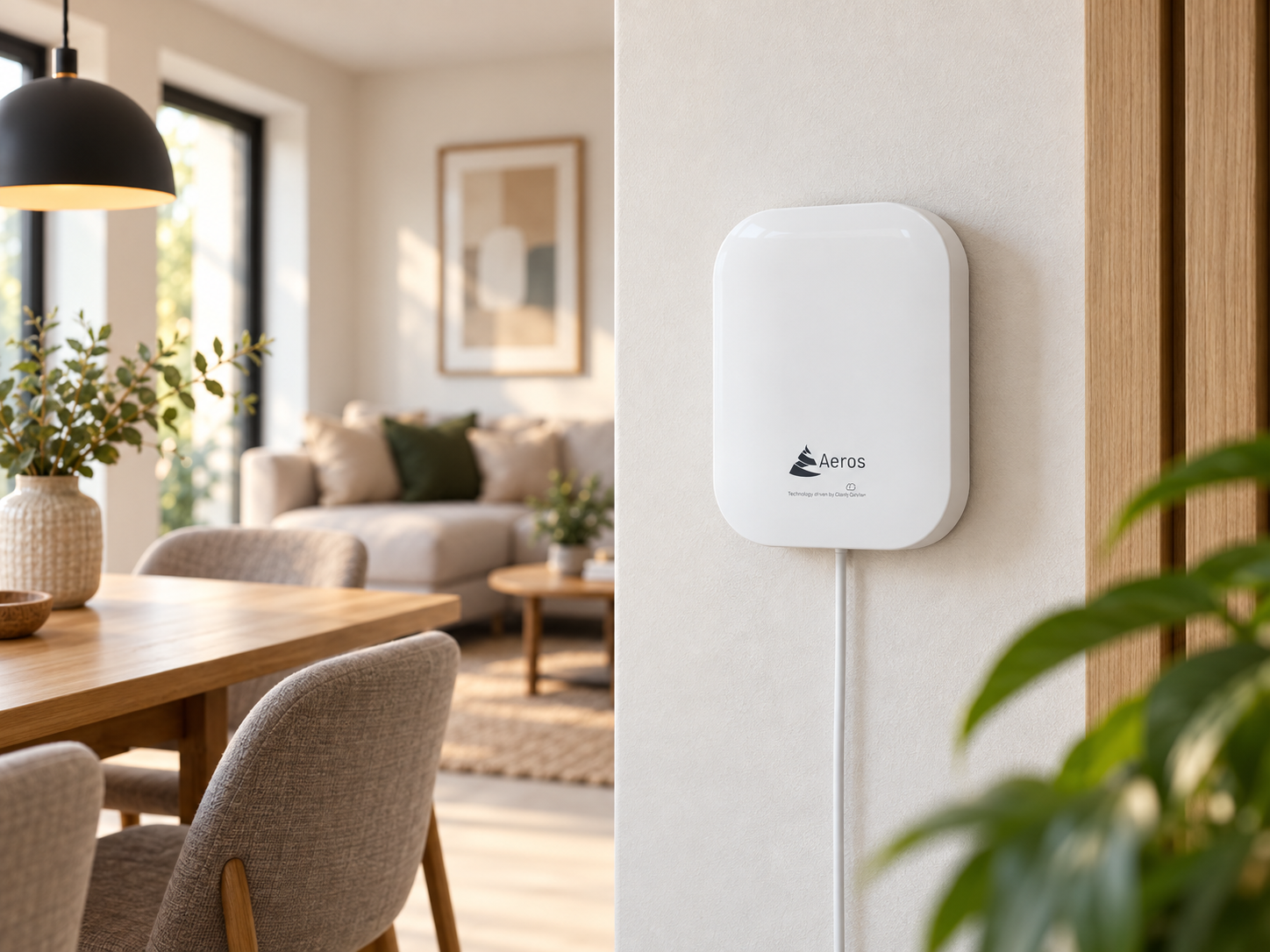
The Aeros particulate matter sensor in our range even measures ultrafine particles down to 0.3 µm. These are extremely small particles such as aerosols and virus particles, which are not picked up by a standard particulate matter sensor.
How exactly does a particulate matter sensor work?
Now that you know how small particulate matter particles are, the logical next question is how a particulate matter sensor actually detects them. Most particulate matter sensors, including the Aeros particulate matter sensor, work using a technique called laser scattering. A small laser shines through an air sample drawn in by the device. As soon as a dust particle passes through the beam of light, it scatters the laser light. An optical sensor picks up this scattered light and uses it to count how many particles are in the air and roughly how big they are. Using this data, the sensor calculates the particulate matter concentration in micrograms per cubic metre (µg/m³), broken down into PM10 and PM2.5.
Most sensors detect particles from around 0.3 µm upwards; anything smaller remains invisible to the device. That's why the Aeros particulate matter sensor measures down to 0.3 µm, so that ultrafine particles are detected too. Do keep in mind that high humidity, above 90%, can affect the measurement: water droplets in the air are sometimes mistaken for dust particles. Ventilating regularly and keeping the sensor clean will give you the most reliable results.
What is the added value of a particulate matter sensor?
Air pollution is a growing problem and carries serious health risks. With short-term exposure, meaning within a few hours to days, you may already experience coughing, shortness of breath and irritation of the eyes, nose or throat. In people with an existing lung condition or heart problems, this can even lead to hospitalisation. Are you exposed long-term, meaning over several years, to elevated concentrations of particulate matter? Then you run a higher risk of cardiovascular disease, chronic lung disease (COPD), worsening asthma and lung cancer.
The smaller the particle, the deeper it penetrates: ultrafine particles, smaller than 0.1 µm, can even end up in the bloodstream. The World Health Organization (WHO) therefore recommends an annual average of no more than 5 µg/m³ for PM2.5 and 15 µg/m³ for PM10, with a peak value of no more than 15 µg/m³ (PM2.5) or 45 µg/m³ (PM10) per day. It's therefore important to keep a close eye on air quality, so that you can take action in good time if needed.
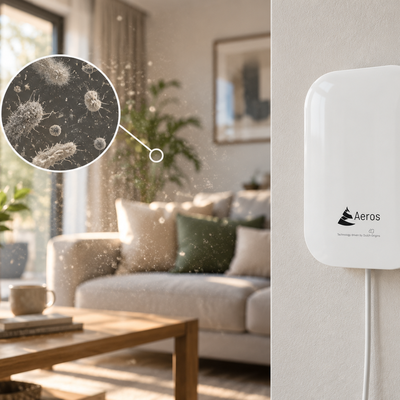
Just because the air looks clean doesn't mean it actually is. The only way to find out how many dust particles are present in the air is to measure it.
How does particulate matter form and what factors play a role?
The amount of particulate matter depends on various causes and can vary greatly throughout the day. Air is usually cleaner around midday than in the morning and late afternoon, because there's less traffic then. The location of your particulate matter sensor also makes a difference: if you're near a motorway, in an industrial area or close to an airport, readings are often higher than in a quiet residential neighbourhood. Particulate matter is, in fact, formed in several different ways.
A large part is released directly by road traffic, wood burning, agriculture and industry, but natural sources such as wind-blown soil dust, pollen, sea salt and wildfires also contribute. In addition, so-called secondary particulate matter is formed: gases such as nitrogen oxides from traffic and industry, ammonia from livestock farming and sulphur dioxide react with each other in the air and form new particulate matter particles. It's precisely on days with high levels of particulate matter in the air that this secondary component is often the biggest culprit.

Buy a particulate matter sensor online, quick and easy, at Ventilationland!
Which ventilation systems reduce fine particulate matter levels in your home?
It's not so much the ventilation system itself, but mainly the filter inside it, that determines whether fine particulates are kept out. Balanced ventilation with heat recovery (MVHR, ventilation system D) is the most effective option here, as this system actively blows outdoor air through a filter before it enters the home. With natural ventilation via vents, or with mechanical ventilation (system C), incoming air enters unfiltered through the façade vents, giving fine particulates free rein.
Within an MVHR system, the filter class determines how much fine particulate matter is actually kept out:
- A G4 filter only stops coarse dust, insects and fluff, but lets fine particulates through unimpeded;
- An F7 or F9 filter, on the other hand, stops a large proportion of fine particulates, soot and pollen, from around 1 µm upwards;
- A HEPA filter captures at least 99.95% of particles from 0.3 µm upwards. This percentage applies to the H13 class, the official minimum at which a filter may be called "HEPA" under the European standard EN 1822, although not every MVHR unit is built to this standard;
- The newer ISO 16890 standard, with its ePM1, ePM2.5 and ePM10 classes, now expresses this even more precisely: the higher the ePM value, the better the filter removes fine particulates.
Don't have balanced ventilation at home? A standalone air purifier with a HEPA filter can then be a great addition to help lower the fine particulate concentration indoors. Want to know whether your ventilation system is actually reducing fine particulates? Measure it yourself: in our blog How do I measure the air quality in my home you'll find a step-by-step guide to doing just that.
Quick summary:
- Fine particulates are dust particles smaller than 10 µm and can be hundreds of times smaller than a human hair;
- A particulate matter sensor uses laser scattering to count particles and convert them into PM10 and PM2.5 values;
- Long-term exposure to fine particulates can harm your health and shorten your life expectancy;
- The Aeros particulate matter sensor from Ventilationland measures fine particulates, ultrafine particulates, CO2, aerosols and TVOC;
FAQ
In the FAQ below, we've put together the most frequently asked questions about fine particulates and particulate matter sensors for you. Do you have specific questions about your situation, or aren't you quite sure? Our experts are here to help, so feel free to get in touch!
The World Health Organization (WHO) recommends an annual average of no more than 5 µg/m³ for PM2.5 and 15 µg/m³ for PM10. Indoors, this can be temporarily higher, for example while cooking, but the lower the value is structurally, the healthier the air you breathe.
PM10 refers to dust particles up to 10 µm, while PM2.5 specifically measures the finer particles up to 2.5 µm. The smaller the particle, the deeper it can penetrate into your lungs, which is why PM2.5 is generally considered more harmful.
Yes, most particulate matter sensors work most accurately if you keep the sensor free of dust and fluff on a regular basis. Some models, including the Aeros particulate matter sensor, calibrate themselves automatically via the accompanying app.
No, fine particulates are too small to assess with the naked eye or by feel. Only a particulate matter sensor tells you for certain how many dust particles are actually present in the air.
For home use, the Aeros particulate matter sensor is an excellent choice. Besides fine and ultrafine particulates, this device also measures CO2, aerosols and TVOC, so you can keep an eye on your home's overall air quality at a glance.
Can we help you with anything else?
At Ventilationland, we think it is important that we can always be reached and answer your questions as quickly as possible. Therefore, you can reach us in several ways, including via chat or WhatsApp. We are happy to help!