
-25%

-
In stock
Recommended price
120.68
-25%
90.50
Item number: 19100090


How clean is the air in your home, really? With a simple check you can find out in no time. Measuring the air quality in your own home is actually not complicated at all! With a CO2 monitor or particulate matter meter (sometimes also called an air quality meter), you can see straight away whether the air quality in your home is good (enough) or not. If it isn't, you immediately know that extra ventilation is needed.
In this blog we explain how you can measure the air quality at home quickly and easily, what healthy indoor air quality actually means, and which substances can cause poor(er) air quality.
Doing your own healthy air check at home? These are the key points:
The air you breathe at home affects you more than you might think. On average, you spend most of your time indoors, so you notice it when that air is of lower quality. The symptoms of poor air quality show up physically, for example as headaches, a tired feeling and irritated airways, and in the longer term as an increased risk of respiratory and heart problems.
Your mental state is also affected by poor air quality at home. Too high a concentration of CO2 or particulate matter in the air can cause a loss of concentration, a drowsy feeling and lower energy levels. With CO2 this works slightly differently than with particulate matter: too much causes symptoms, but too little cannot occur. Ventilation can never bring the CO2 level in your home below the level of outdoor air (around 420 ppm). And that level is actually the healthy baseline we're used to in everyday life.
People with COPD or another lung condition, children and older people especially tend to notice the effect of air quality more strongly. Good air quality is therefore not a luxury, but a direct basis for how fit and sharp you feel at home. You can read how to check for yourself whether your air quality is good enough in the next chapter.
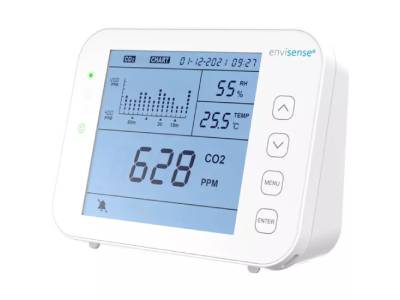
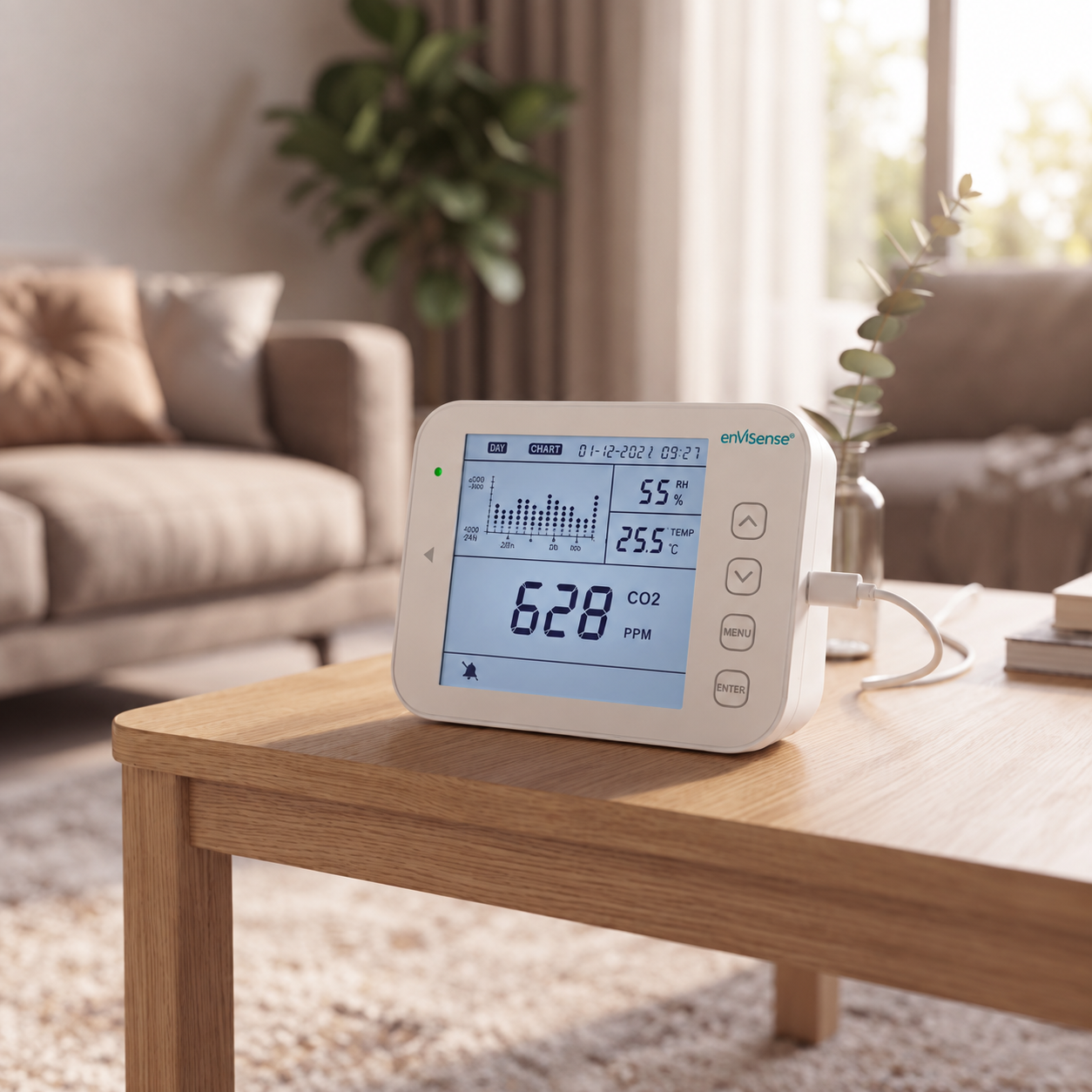
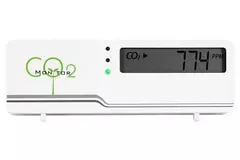
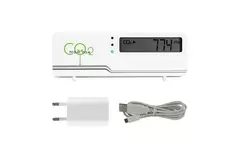
Do you already have a CO2 monitor at home, by the way? A reliable product from our range that we highly recommend is the CO2 Monitor EnviSense with datalogger, including digital dashboard. Below you can see what the benefits and advantages are.
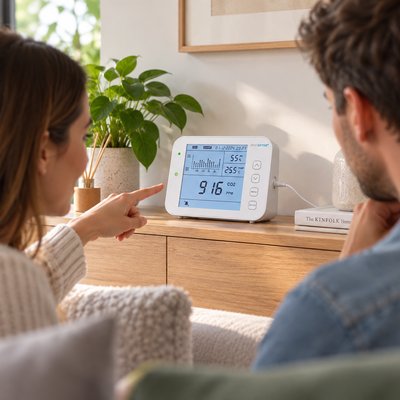
Measuring air quality doesn't have to be complicated, and you don't necessarily need to have it measured by a specialist. You can easily measure the air quality in your home yourself with a CO2 monitor! With this, you can see within no time how much carbon dioxide (in ppm, parts per million) is present in the air in a particular room, often supplemented with a humidity and temperature reading.
This gives you a clear, direct picture of how your ventilation is currently performing. And because you can leave the CO2 monitor in the same spot (or hang it there), you can also track exactly how the air quality changes over time. When extra ventilation is needed, you automatically receive an alert from the CO2 monitor. This is often a beeping signal.
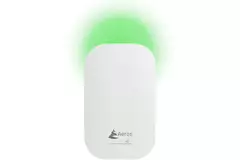
Want a more complete picture of the air quality at home, including particulate matter, the TVOC value and aerosols? Then a particulate matter meter is a valuable addition. With this, measuring particulate matter at home is just as easy as measuring CO2.
Not every substance in the air is equally important to keep an eye on, by the way. The overview below gives you a clear picture of which factors influence your air quality, with a colour code that shows how significant the impact on your health is.
Not every substance in the air is equally important to measure. To make it extra easy and clear for you, we've shown below what kind of impact a number of substances can have on your health. We've divided these from high (red, life-threatening) to low (green, less important). Want more explanation about a specific substance? Just click on it and more information will automatically appear.
red = life-threatening yellow = very important blue = important green = less important
A colourless, odourless gas produced by incomplete combustion, for example from a faulty boiler, gas heater, water heater or open fireplace. Smoke alarms and CO alarms actively monitor this gas.
Radioactive noble gases that occur naturally from the ground, via crawl spaces, and from masonry building materials such as concrete.
Tiny airborne particles from soot, smoke, cooking fumes, wood burning, candles and outdoor traffic, which you can breathe back in.
Harmful gases released when cooking on gas, heating oil or fat (acrolein), and burning wood or candles. Exhaust fumes from factories and vehicles also fall under this.
The amount of water vapour in the air; between 40 and 60 percent is healthy.
The gas that you and your pets breathe out.
A specific, common and carcinogenic gas released from chipboard, MDF, laminate, glue, paint and new furniture.
Total Volatile Organic Compounds: an umbrella term for hundreds of chemical gases from cleaning products, perfume, cosmetics, paint, building materials and air fresheners.
Airborne particles from mould, house dust mites (droppings), outdoor pollen and pet dander.
Visible dust, textile fibres, hair and blown-up sand.
Warmth in the room, which directly affects humidity.
In concrete terms, the overview above means that almost everything in your home affects your air quality: from the number of people and pets in your household to your boiler, gas stove, cleaning products and water vapour from the shower and tap. That's why we want to stress once again that good ventilation is crucial! It quickly removes polluted air and ensures fresh, clean air comes in to replace it. This can be done through natural ventilation (airing via windows and vents) or through a system such as mechanical ventilation or an MVHR unit.
Please note: the area around your home also plays a role. If you live near an industrial area or a busy road, the nitrogen dioxide level in the outdoor air is, on average, higher. Extra, controlled ventilation is then even more important, to prevent that pollution from building up indoors.
Every room in your home has its own influence on your air quality. Think, for example, of:
Living room
Multiple people often spend extended periods here, leading to a higher CO2 concentration, along with TVOCs from furniture, flooring, electronics and any candles or wood burning.
Kitchen
Particulate matter and humidity from burning fat and cooking fumes; if you cook on gas, nitrogen dioxide is added too. An extractor hood quickly removes most of these substances.
Bedroom
Due to the long time spent here overnight combined with perspiration, CO2 and humidity levels often rise in bedrooms.
Bathroom
Mainly humidity, and with prolonged exposure to relative humidity above 70 percent, also an increased risk of mould spores. If there's also a toilet in your bathroom, TVOCs and aerosols play a role too.
Toilet
TVOCs and aerosols, the fine bacterial water droplets released when flushing, along with chemical fumes from things like toilet cleaners and air fresheners.
Basement
Radon gas due to direct contact with soil and stone walls, humidity from often limited ventilation, and TVOCs from storing things like paint.
Crawl space
Radon gas and humidity, as exposed soil and foundations continuously release moisture and natural radioactive gases that rise upward.
Attic
Formaldehyde and TVOCs, as high temperatures in summer cause insulation material, roof panels and stored chipboard furniture to release chemical gases faster.
Garage (attached or integral)
Carbon monoxide, TVOCs and particulate matter: a starting car or motorbike emits a lot of CO, particulate matter and exhaust fumes in a short time, and petrol, oil, tyres and workshop products continuously release volatile substances that can drift into the house.
Utility room or workspace
Humidity and mould spores from a running washing machine, laundry drying on a rack (up to 2 litres of water per wash), and the condensation or exhaust from a tumble dryer.
Meter cupboard or technical room
Radon and humidity, as pipe penetrations and the floor opening are often not sealed airtight, causing the room to draw moisture, mould spores and radon gas into the home like a kind of chimney.
We've left the aspect of "temperature" out of this overview. Heated rooms do affect humidity, but normally have only a minimal effect on air quality.
Item number: 19100090
Item number: 19100099
Item number: 19100096
Item number: 19100098
Item number: 19100093

Is anything still unclear after reading this blog? Or do you have questions about a specific product? Then we're here to help. You can reach us in several ways, including via WhatsApp and chat!
In the FAQ below, we've clearly listed the most frequently asked questions about measuring your air quality. Do you have specific questions about your situation, or aren't you quite sure? Our experts are happy to help, so feel free to get in touch!
A CO2 level up to 800 ppm is considered good, 800 to 1,200 ppm is considered moderate (time to ventilate), and above 1,200 ppm is considered too high. This guideline is used by the Gezondheidsraad and RIVM (Dutch health authorities); there is no strict legal standard for CO2 in homes, but this guideline is the commonly used reference.
A standard CO2 monitor only measures CO2, often supplemented with temperature and humidity. If you also want to track particulate matter, TVOC and aerosols, you'll need a particulate matter meter.
For a complete picture, we recommend continuous monitoring with a meter that has a datalogger, especially in rooms where you spend a lot of time, such as the living room and bedroom. If you only want to check occasionally, a simple measurement while the room is in use is enough. Thanks to automatic self-calibration, you can simply take the monitor to a different room, as long as that room gets properly ventilated from time to time.
The most important step is sufficient ventilation, both natural via windows and vents and mechanical with a mechanical ventilation system that continuously brings in fresh air and removes polluted air. It also helps to remove the source of the pollution as much as possible, think of cooking with the extractor hood on, not smoking indoors, and removing moisture in time to prevent mould. With a CO2 monitor such as the EnviSense CO2 monitor, you can also see exactly when it's time to ventilate extra. Notice that particulate matter remains a persistent problem, for example due to a busy road nearby? Then an air purifier can help as an addition to further purify the indoor air.
At Ventilationland, we think it is important that we can always be reached and answer your questions as quickly as possible. Therefore, you can reach us in several ways, including via chat or WhatsApp. We are happy to help!