
-25%

-
In stock
Recommended price
120.68
-25%
90.50
Item number: 19100090

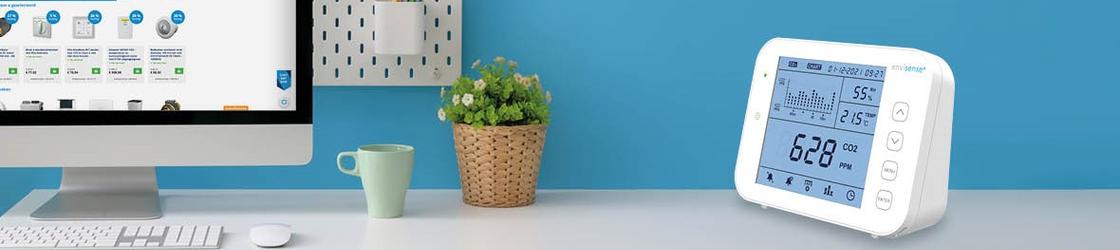
Do you ever feel a bit drowsy on the sofa in the afternoon? Or do you sometimes wake up with a heavy head? Then the air in your home may not be refreshed often enough, allowing the CO2 level to rise too high. After all, you can't see or smell CO2 (carbon dioxide). A CO2 monitor makes the CO2 level visible. That way, you can see at a glance when it's time to ventilate (more), and you stay in control of a fresh and healthy indoor climate.
In this blog, you'll read how a CO2 monitor works and where best to place it. Next, we explain how to read the monitor, what ppm means and which CO2 levels are healthy. Finally, we set out the difference between a CO2 monitor and a particulate matter monitor.
The key points from this blog at a glance:
What exactly is CO2? CO2 is short for carbon dioxide, a colourless and odourless gas that occurs naturally in outdoor air. Your body produces it too: every time you breathe out, a little CO2 enters the room. If little fresh air comes in, the CO2 level keeps rising. A CO2 monitor (also called a CO2 meter or carbon dioxide detector) measures how much CO2 is in the air and shows whether a room is ventilated well enough.
The heart of a CO2 monitor is the sensor. Most reliable CO2 monitors use an NDIR sensor. NDIR stands for non-dispersive infrared, in other words an infrared sensor. You can't see infrared light with the naked eye. CO2 molecules have a special property: they absorb a very specific part of infrared light, while the other gases in the air hardly do so at all. So the more CO2 there is in the air, the more of that light disappears. By measuring how much light is left, the sensor knows exactly how much CO2 is in the air.
From the air in the room to a number on your screen, this is how a CO2 measurement works:
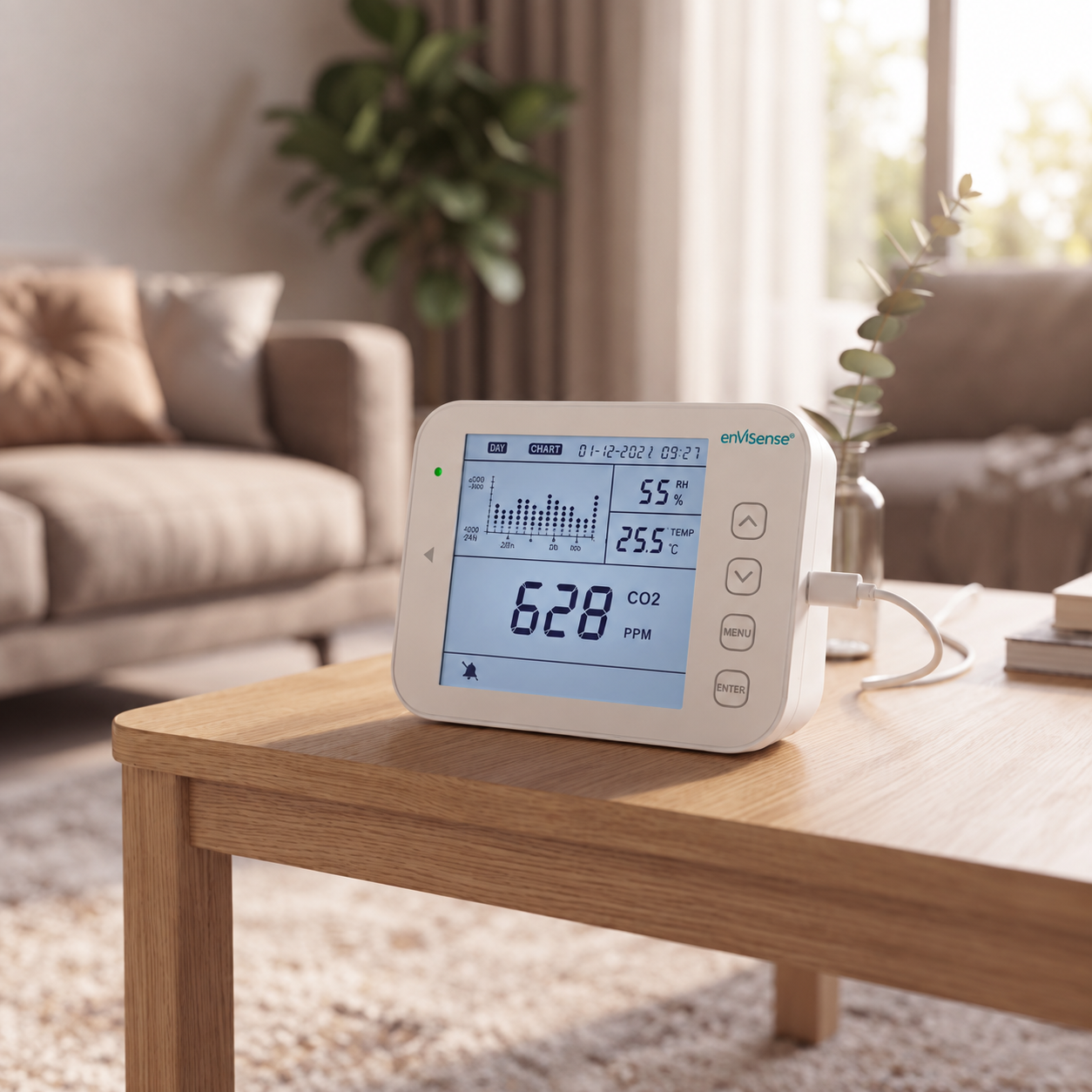
Because the sensor measures the CO2 level directly, this is an accurate and stable way of measuring. When choosing a CO2 monitor, do pay close attention to the following: some cheap CO2 monitors don't have a real CO2 sensor, but a sensor that measures volatile compounds in the air. Based on that, they estimate a CO2 value (often referred to as eCO2). That estimate can differ considerably from reality. That's why all CO2 monitors in our range have an NDIR sensor. Not sure which one to choose? In our blog 'The top 5 best CO2 monitors', we list the best models from our range for you.
Every NDIR sensor can start to deviate slightly over time. This is called drift. By calibrating your CO2 monitor, you restore its accuracy. This is usually done in outdoor air: you place the monitor outside or in an open window for a while, so it can use the fresh outdoor air as a reference point. For example, you place the EnviSense CO2 monitor outside or in an open window for at least 20 minutes, then start the calibration via the menu. Some other monitors calibrate automatically. We recommend calibrating your CO2 monitor at least once a year.
Even the best sensor only measures accurately if it's in the right place. With these four tips, you'll get the most reliable readings from your CO2 monitor:
At head height when seated
Place the CO2 monitor at roughly table height or mount it on the wall, at the height where you breathe when sitting down. That way, you measure the air you actually breathe in.
Not too close to people
If you breathe directly onto the monitor, the reading will shoot up. So keep a distance of around 1 to 2 metres from where people are sitting.
Away from windows and vents
Place the CO2 monitor at least 1.5 metres from an open window, door or ventilation grille. Otherwise it mainly measures the incoming outdoor air, giving you an overly rosy picture.
In the room where you spend most time
Measure in the living room, the bedroom or your home office. That's exactly where you spend a lot of time and where the CO2 level rises fastest.
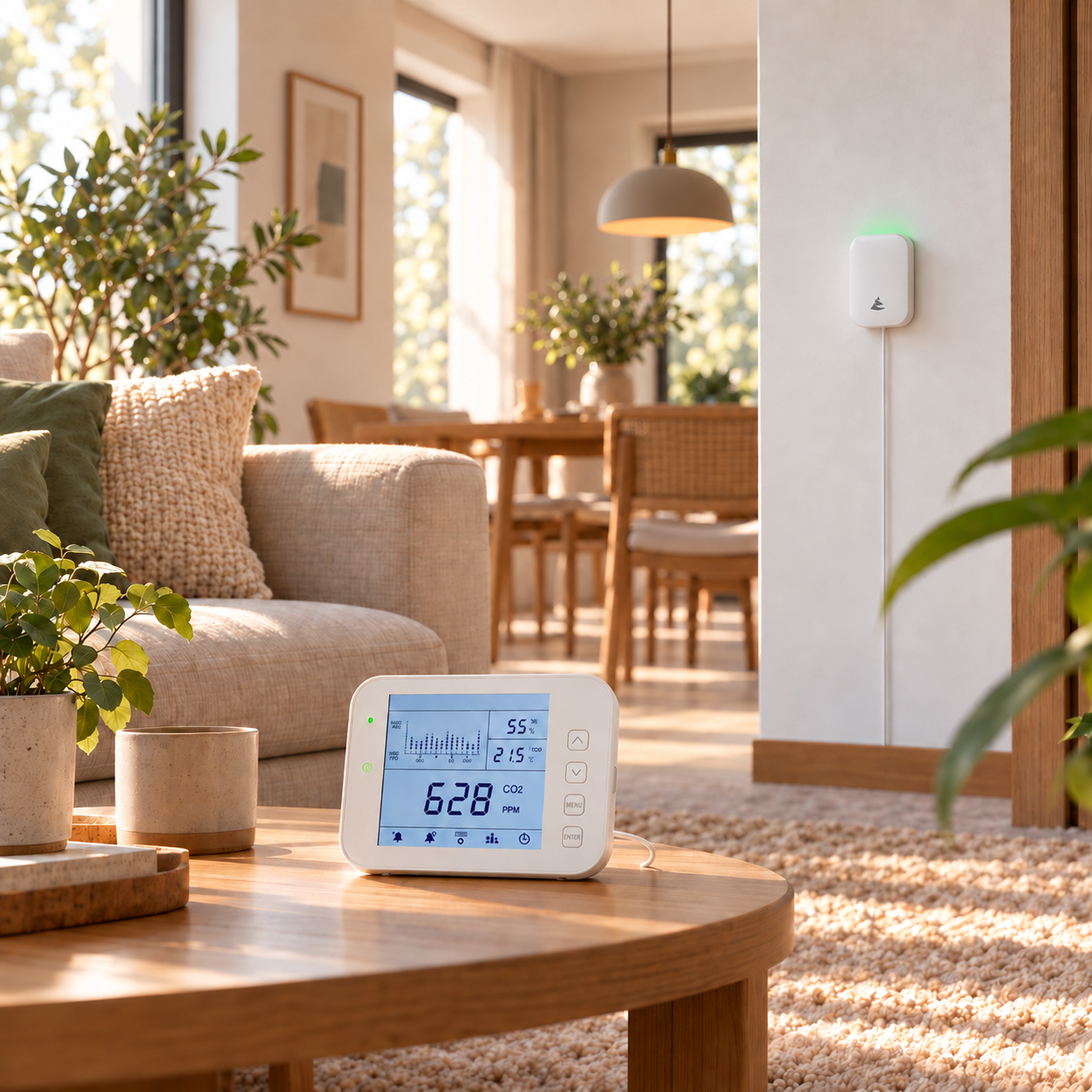
Is your CO2 monitor in the right place? Then it's time to look at what it's telling you. The most important number on the screen is the CO2 level. This is always shown in ppm (parts per million), for example 650 ppm. The higher that number, the more CO2 there is in the air and the less fresh air is coming in.
Many CO2 monitors make it extra easy with a traffic light function. A green, orange or red light shows at a glance whether the CO2 level is fine or whether you need to ventilate. You can read which CO2 levels match which colour further on in this blog. Many CO2 monitors also display the temperature and relative humidity (RH). These figures mainly tell you something about comfort: is it warm or cold, dry or clammy? They don't tell you whether enough fresh air is coming in. For that, the CO2 level remains the number to watch.
When reading your monitor, don't just look at a single measurement, but above all at the trend. Do you see the CO2 level rise quickly when you have visitors, or at night in the bedroom with the door closed? Then you know exactly when you need to ventilate more. CO2 monitors with a memory and logging function, such as the EnviSense, help you with this. The memory stores all measurements and the logging function lets you review them later in a graph. That way, you can see exactly how the CO2 level develops throughout the day.
You've already come across the term a few times: ppm. But what does ppm actually mean? Ppm stands for parts per million. Air is made up of all kinds of gas molecules, mainly nitrogen and oxygen. For a CO2 monitor, ppm indicates how many CO2 molecules there are among one million air molecules.
A CO2 level of 1000 ppm therefore means that for every million air molecules, 1000 are CO2 molecules. That's 0.1 percent of the air. That sounds like very little, and it is. That's exactly why ppm is used: with such small amounts, percentages are impractical, whereas ppm lets you clearly see small differences.

Now that you know what ppm means, you can put the CO2 levels on your monitor into context. Most CO2 monitors use this classification:
Green
Below 800 ppm
All good! Enough fresh air is coming in for a fresh indoor climate.
Orange
800 to 1200 ppm
Time for action! Open a window or trickle vent before the air quality gets worse.
Red
Above 1200 ppm
The room is getting far too little fresh air. Ventilate immediately!
These figures aren't plucked out of thin air. The Health and Safety Executive (HSE) states that a consistent CO2 level below 800 ppm is likely to indicate a well-ventilated space, while an average of 1500 ppm over the occupied period indicates poor ventilation. So if your CO2 monitor stays on green, you're in good shape.

A common misconception is that CO2 is toxic at these levels. That's not true: CO2 itself only has a direct effect on your body at around 5000 ppm. The problem lies in what a high CO2 level means: too little fresh air is coming in. As a result, other things build up too, such as moisture, odours, volatile compounds from furniture and cleaning products, and viruses and bacteria that people breathe out.
So see the CO2 level as a warning light. A monitor on red doesn't tell you that CO2 is making you ill, but that you're breathing air that has already been breathed in many times and in which all sorts of things have built up. It's precisely this build-up that can affect your wellbeing and health over time. You can read which complaints are associated with this and how they arise in our blog on CO2 and humidity as a cause of health problems.
There's also a study that looks at the effect of CO2 on your thinking ability. In 2012, researchers from the State University of New York and Lawrence Berkeley National Laboratory had test subjects carry out decision-making tasks at 600, 1000 and 2500 ppm. At 1000 ppm, they already scored slightly lower on some of the tasks, and clearly lower at 2500 ppm. Later studies didn't all reach the same conclusion, so the science isn't fully settled yet. Either way, a CO2 monitor showing green is always a safe choice.
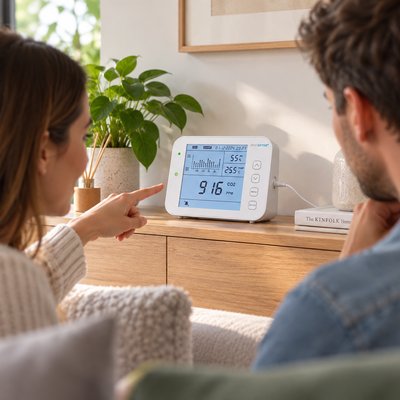
Already have a CO2 monitor at home? Enter the current CO2 reading from your monitor below and you'll see straight away whether you're on the right track. Is your CO2 level too high? Then we'll tell you what measures you can take.
Does your CO2 monitor regularly jump to orange or red, even with the window ajar? Then natural ventilation probably isn't enough in that room. Mechanical ventilation actively removes stale air from your home, whatever the weather. It does require a ductwork system running through your home. If you don't have one yet, installing it isn't a quick job.
A quicker solution is a single-room MVHR unit. MVHR stands for mechanical ventilation with heat recovery. You install a unit like this in the outside wall of each room, so there's no need for ducts throughout the house. Single-room MVHR extracts stale air, supplies fresh air and uses the heat from the extracted air to pre-warm the incoming air. That way, you can ventilate even in winter without your home getting cold. Whichever solution you choose, your CO2 monitor lets you check straight away whether the room stays on green.
A CO2 monitor therefore shows how much CO2 is in the air, and indirectly whether enough fresh air is coming in. But clean air is more than just well-ventilated air. That's where the particulate matter monitor comes in.
The big difference lies in what is measured. A CO2 monitor measures one specific gas: CO2. Indoors, this gas mainly comes from the people in the room, because we breathe it out. A particulate matter monitor doesn't measure gas, but tiny floating dust particles just a few micrometres (µm) in size. Some of these fine particles come from outside, for example from traffic. But they're also simply created at home, by cooking, a burning candle or a wood burner.
That's why the CO2 level can be neatly on green, while the air is still full of fine particles after frying a pancake. And vice versa: a room without fine particles can still be poorly ventilated.
Good to know: many particulate matter monitors also measure CO2. The Aeros Pro, for example, measures not only fine particles but also CO2, aerosols and volatile organic compounds (TVOC). A particulate matter monitor like this therefore has almost all the functions of a CO2 monitor, and more. Want to know both whether you're ventilating enough and how clean the air is? Then a particulate matter monitor with CO2 measurement is a smart choice. You can read how a particulate matter monitor counts the particles in our blog: 'What is a particulate matter sensor?'
You can't see or smell CO2, but with a good CO2 monitor you always know where you stand with the CO2 level at home. Choose a CO2 monitor with an NDIR sensor, place it in the right spot and keep it on green. That way, you ensure a healthy indoor climate and no longer wake up groggy after a night's sleep with the door closed.
In short: how to measure CO2 at home
Item number: 19100090
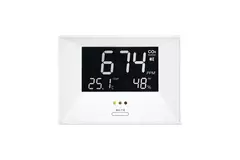
Item number: 19100099

Item number: 19100093
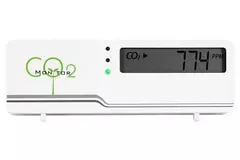
Item number: 19100096
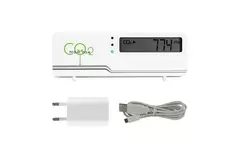
Item number: 19100098
In the FAQ below, we've clearly listed the most frequently asked questions about CO2 monitors and ppm levels. Do you have specific questions about your situation or can't quite find the answer? Our experts are ready to help, so feel free to get in touch!
CO2 is the chemical formula for carbon dioxide. It's a colourless and odourless gas that occurs naturally in outdoor air and that people and animals breathe out. Indoors, CO2 builds up when there isn't enough ventilation. That's why the amount of CO2 is a good indicator of how fresh the air in a room is.
Ppm stands for parts per million. For CO2, it indicates how many CO2 molecules there are among one million air molecules. A CO2 level of 800 ppm therefore means that for every million air molecules, 800 are CO2 molecules. That's 0.08 percent of the air.
Outdoor air contains just over 420 ppm CO2, and indoors the CO2 level is always somewhat higher. A level below 800 ppm is a good level indoors. Bear in mind, though, that the CO2 level can fluctuate considerably. For example, are two people sleeping in a small bedroom with the door and windows closed? Then the CO2 level can rise to well above 1200 ppm in a single night.
No. Carbon monoxide (CO) is a different, highly toxic gas released by poor combustion, for example from a faulty boiler, gas fire or wood burner. A CO2 monitor doesn't measure carbon monoxide and therefore won't warn you about it. Do you have a fuel-burning appliance at home? Then always fit a carbon monoxide alarm as well.
We recommend calibrating your CO2 monitor at least once a year. This is done in outdoor air: place the monitor outside or in an open window for a while and then start the calibration. Exactly how this works differs per monitor, so check the manual of your CO2 monitor.
Unfortunately, that isn't possible reliably. CO2 is colourless and odourless, so you only notice a CO2 level that's too high through complaints such as drowsiness or headaches, or through stuffy air. A CO2 monitor with an NDIR sensor is the only way to really measure the CO2 level and know exactly when to ventilate.
At Ventilationland, we think it is important that we can always be reached and answer your questions as quickly as possible. Therefore, you can reach us in several ways, including via chat or WhatsApp. We are happy to help!