
-30%
In stock
Recommended price
1,836.00
-30%
1,285.20
Item number: 81002210


A day out walking, an afternoon at the beach, coming back to your camper or caravan and then... a wave of stuffy, warm air. Especially in summer, that's not a pleasant prospect. A camper or caravan air conditioner makes sure you always have a pleasant temperature inside, no matter how warm it is outside. In this blog we explain what a camper or caravan air conditioner actually does, what options are available within our range, and how to calculate the right capacity. Of course, we're also happy to help you make the best choice for your cool camper and/or caravan!
The key points from this blog at a glance:
A camper or caravan air conditioner is a compact cooling system that cools the air inside your vehicle, and with most inverter models, heats it too. That's great, because a camper or caravan is often used for outdoor living. It can happen that you're out in full sun all day, and the inside heats up quickly. Cool air is then not a luxury, but simply pleasant for your own comfort and that of others.
That's especially true for a camper, since it's a single vehicle: as the driver, you'll get just as hot and bothered as your passenger. But in a caravan too, you don't want to step in and find yourself in a compact space filled with muggy, warm air.
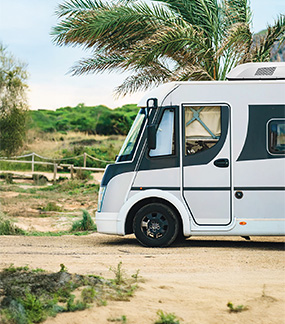
A camper is a single vehicle in which you both drive and stay, while a caravan is a separate living unit that you tow behind the car. For the products in our range, it makes no difference whether you use the air conditioner in a camper or in a caravan. These units are suitable for both, regardless of the make or type of vehicle.
What really matters is the layout and build of your specific camper or caravan. Do you have a roof window that can open? And how big is the space you want to cool? These kinds of things determine which solution suits you best. Besides our rooftop air conditioners, our website offers one more option to keep your camper or caravan cool during warm summer and/or holiday days. Below you'll find some more detailed information about the different options you can choose from with us. When you click on an image or blue link, you'll immediately see all available products.
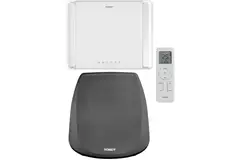
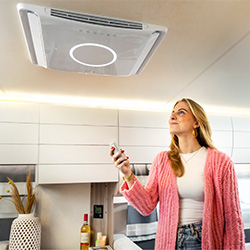
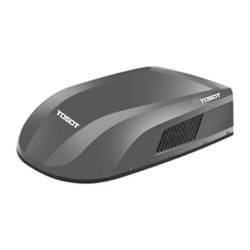
The rooftop air conditioner is the most popular option, and the only variant we offer at Ventilationland specifically for campers and caravans. You simply mount the rooftop air conditioner in the roof window, so it takes up hardly any practical space and stays completely out of sight. What's more, a rooftop air conditioner works very efficiently: warm air rises and cool air sinks, so a position in the roof is the most logical place to cool from. Our range consists of durable inverter models from Tosot that can heat as well as cool.
Don't have a roof window (or can't yours open)? Then a portable air conditioner is a great alternative. You simply hang the duct outside through a window or door to vent the warm air. Just make sure you use a window seal or door seal, otherwise the warm air will still come back in through the gap. Want to know more about the right flexible duct for a portable air conditioner? Read our blog about it.
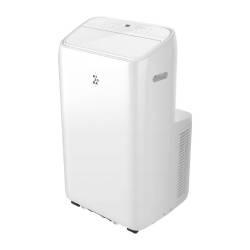
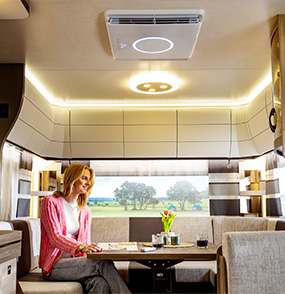
The choice between a rooftop air conditioner and a portable air conditioner depends on a few practical factors. First, check whether your camper or caravan has a roof window that can open and close. If it does, check the dimensions of the roof window and compare them with the measurements listed on the rooftop air conditioner's product page, so you're sure it will fit.
Also think about the power supply: our rooftop air conditioners run on 230V, so check whether you can connect to this, for example via shore power at the campsite. If all of this checks out, a rooftop air conditioner is a logical choice: it takes up no practical space and works efficiently because the unit sits at the top of the vehicle. Keep in mind that your camper/caravan will become a few centimetres taller once a rooftop unit is fitted.
Don't have a roof window, or can't yours open? Then a portable air conditioner is usually the best alternative. In that case, make sure you can safely route the duct outside via a window or door over a short distance, and use a window seal or door seal so the warm air doesn't still come back in. Not sure which of the two options to choose? Then also look at the size of the space you want to cool: for a larger camper or caravan, a rooftop air conditioner usually provides the best and most consistent cooling.
Do you know which type of air conditioner you need? Then the next step is choosing the right capacity. Too little power means your camper or caravan air conditioner won't cool enough on hot days. On the other hand, you'll pay too much in (energy) costs for an air conditioner that's "too powerful". Below you can see how to calculate the required capacity, and you can also use our handy calculator tool. Not sure about the right calculation for your situation? Feel free to contact us. We're happy to think it through with you.
Calculate the volume of your camper or caravan in cubic metres (length x width x height).
Choose the heat factor that fits your situation: 35 (well insulated, shady spot), 40 (average insulation, sunny spot) or 50 (moderate insulation, hot destination).
Multiply the cubic metres by the heat factor. That gives you the required wattage.
Divide this wattage by 1,000 for the required power in kW.
Please note: our Tosot rooftop air conditioners are inverter models. That means they automatically adjust their power to the actual cooling demand via a thermostat, instead of constantly running at full power. Does your calculated capacity turn out lower than the smallest rooftop air conditioner in our range (2.65 kW)? Then that's not a problem: the unit simply regulates itself back to the required level. If you end up well above your calculated need, you'll pay unnecessarily much for a heavier and more expensive unit than needed. Keep this in mind!
Item number: 81002210
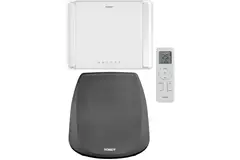
Item number: 81002211

Item number: 81001291
Item number: 81001028
Besides the right type and the right capacity (kW), there are a few more practical points to keep in mind:
Connection and dimensions
Always check whether the air conditioner fits your roof window or connection.
Voltage
Our rooftop air conditioners run on 230V and require up to around 950 watts of power. So you'll need a connection to shore power (campsite) or sufficient battery capacity with an inverter. A standard onboard battery is usually not strong enough.
Cost
A rooftop air conditioner is usually more expensive than a portable one. The Tosot camper/caravan air conditioners in our range cost around €1,400. A portable air conditioner is often somewhat more affordable.
Weight
A rooftop air conditioner weighs around 30 kilos on average (for our rooftop air conditioners, the outdoor unit on the roof is about 29.5 kg, plus a light indoor unit of about 2.7 kg). A portable air conditioner is considerably lighter and doesn't need to be mounted on the roof.
Noise level
Check the number of dB(A) in the product specifications: the lower this number, the quieter the air conditioner.
Heating function
Inverter air conditioners can often heat as well as cool. Very handy on any (holiday) days when it's a bit colder.
Loss of daylight
With a rooftop air conditioner, the unit takes up the place of your roof window, so less daylight comes in.
Technology
Newer inverter air conditioners are often quieter and more energy-efficient during continuous use than older models.
Installation
With a portable air conditioner, you only need to plug it into a socket. A rooftop air conditioner requires more technical knowledge, such as watertight sealing of the opening and routing the power cables.
If a rooftop air conditioner is possible in your situation, this is our recommendation: it takes up no practical space and is easy to mount on a suitable roof window. If this isn't an option, choose a portable air conditioner instead, but make sure you secure it properly while driving so it can't shift. Going for a rooftop air conditioner? Then proper installation is important. Don't have the right technical knowledge, or aren't you very handy with this? Then have the installation carried out by a certified installer.
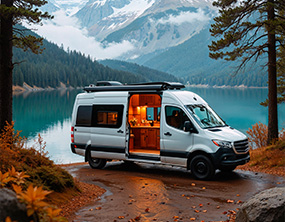
Now that you know what options are available, how to calculate the right capacity, and what to look out for, you can make a well-considered choice for your camper or caravan. View our complete range here of rooftop air conditioners for campers and caravans.
The key points from this blog at a glance:
Do you still have questions about choosing the right camper or caravan air conditioner? Our specialists are happy to help! You can reach us via WhatsApp, chat, phone or email, among other channels.
Below you'll find a number of popular questions about a camper or caravan air conditioner. Click on the question or the blue arrow on the left to view the answer. Is anything still unclear after reading? Let us know!
No. Our rooftop air conditioners run on 230V mains power, which isn't available while driving, and they're not designed or tested for use while driving. So only use your air conditioner at the pitch.
This varies per model, but expect a total weight of around 30 kilos. For our rooftop air conditioners, the outdoor unit that goes on the roof weighs around 29.5 kilos, and the indoor unit around 2.7 kilos.
This varies per model and fan setting. For our rooftop air conditioners, the noise level of the indoor unit is between 35 and 53 dB(A), depending on the setting chosen, and the outdoor unit on the roof produces around 54 dB(A).
Not easily in practice. Our rooftop air conditioners run on 230V and require up to around 950 watts of power, which calls for a substantial battery pack with a suitable inverter or a connection to shore power. A standard onboard battery is usually not sufficient for this.
Yes, our rooftop air conditioners are inverter models that can heat as well as cool. This way you can keep your camper or caravan at a pleasant temperature all year round.
You can install a portable air conditioner yourself: you hang the duct outside and plug it into a socket. A rooftop air conditioner requires more technical knowledge, including watertight sealing of the opening in the roof window and routing the power cables. Not very handy with this? Then it's wise to have the installation carried out by a certified installer.
You mount a rooftop air conditioner in the roof window, so it takes up no space and works efficiently because warm air rises. A portable air conditioner stands freely in the space and is connected via a duct to the outside, ideal if you don't have an opening roof window. A rooftop air conditioner is usually more expensive and heavier, a portable air conditioner is often more affordable and lighter.
At Ventilationland, we think it is important that we can always be reached and answer your questions as quickly as possible. Therefore, you can reach us in several ways, including via chat or WhatsApp. We are happy to help!