
-25%
-
In stock
Recommended price
97.25
-25%
72.94
Item number: 19100098


Headaches at the end of the day, struggling to concentrate or sleeping restlessly at night. We often put this down to stress or a busy (work) week. Yet the cause often lies in the air indoors. In every room where people are present, the CO2 level rises. When it rises too far, it can affect your energy levels, your ability to concentrate and your sleep.
The good news: with a few simple steps, you can quickly make the air in your home fresh and healthy again. A CO2 monitor, for example, tells you how high the CO2 level in your home is, so you know when to ventilate. In this blog, you'll read about the different CO2 levels and what they mean, what a healthy CO2 level in your home is, which health complaints a high CO2 level can cause and what you can do yourself to lower the CO2 level again.
The key points from this blog at a glance:
Every time you breathe out, CO2 enters the air. When there are (too) many people in a room and too little fresh air comes in, the CO2 level in that room keeps rising. The amount of CO2 in the air is expressed in ppm (parts per million). A CO2 level of 1000 ppm means that 1000 out of every million air particles consist of CO2. Simply put: the higher the CO2 level, the less fresh air there is in the room.
In outdoor air, the CO2 level is around 420 ppm. Indoors, the CO2 level is always somewhat higher, because you breathe, cook and sleep there. To assess whether the CO2 level in your home is healthy enough, we use a scale with four levels. We've set these out for you in a clear overview below.
400 to 800 ppm
The air in your home is fresh enough. You don't need to do anything.
800 to 1200 ppm
Too little fresh air is coming in. Ventilate more to lower the CO2 level.
1200 to 2000 ppm
There is clearly too little fresh air. Ventilating is now really necessary.
Above 2000 ppm
The air is unhealthy. Let fresh air in as quickly as possible!
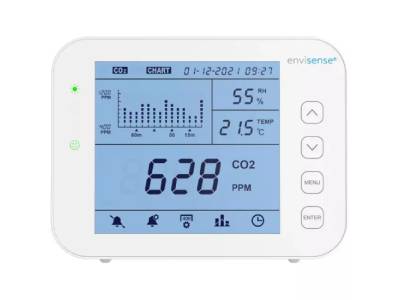
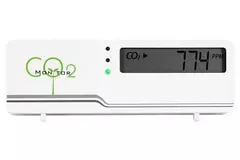
But how do you know how high the CO2 level in your home is? You measure it with a CO2 monitor. Most CO2 monitors use a specific colour to show the state of the air quality. So you don't need to be an expert to understand the reading. Would you like to know exactly how a CO2 monitor works? You can read about it in our separate blog. Many CO2 monitors also measure humidity. Want to know what the measured humidity tells you? Click here to read our blog about humidity in the home.
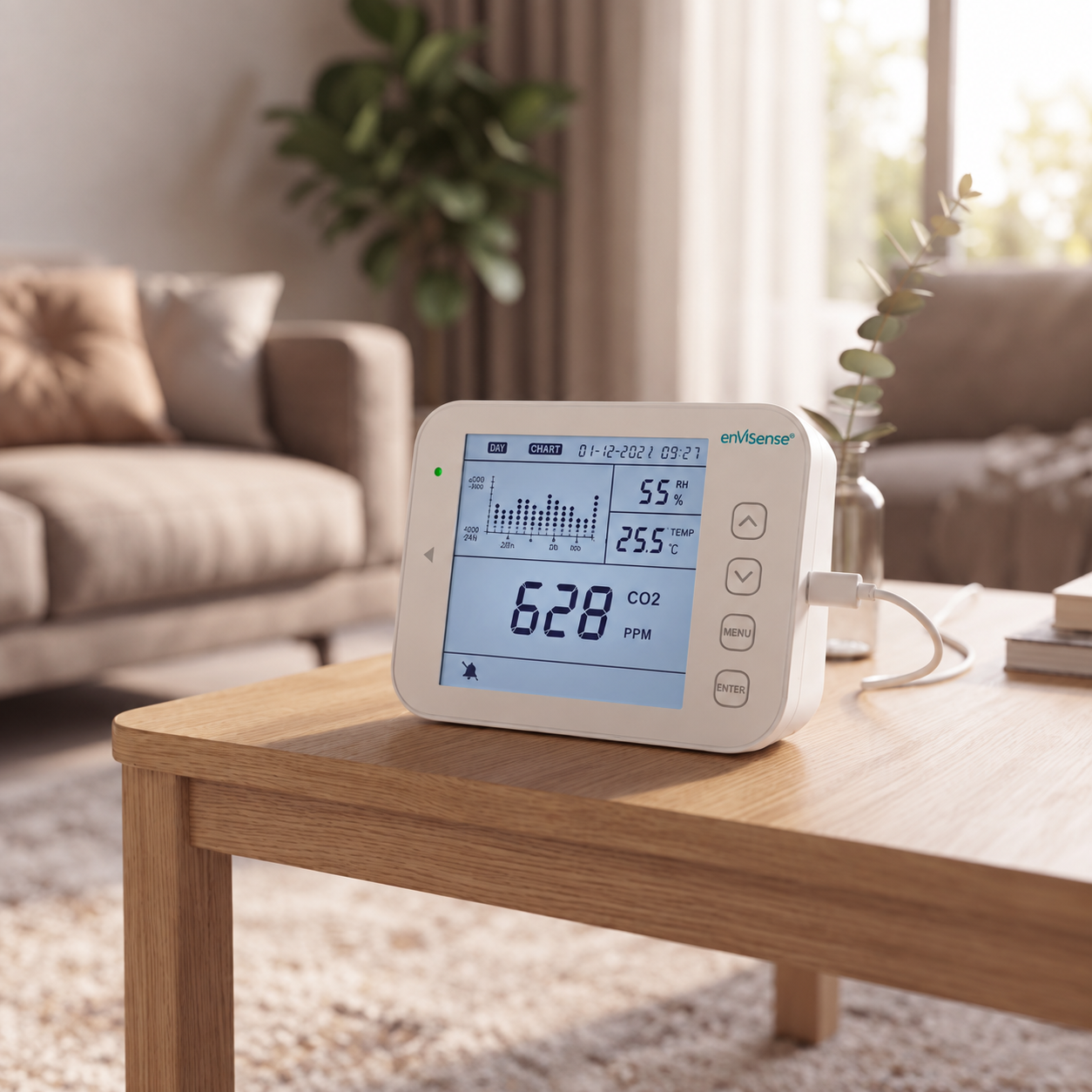
Now that you know the scale, the question is: what CO2 level do you want to achieve in your home? A healthy CO2 level in your home is below 800 ppm. Does the CO2 level occasionally reach between 800 and 1000 ppm, for example when you have visitors or have just been cooking? That's not a problem, as long as the CO2 level drops back below 800 ppm once the cause has gone. Think of around two hours after your visitors have left or after the cooker hood has extracted the cooking fumes.
Does the CO2 level stay above 1000 ppm for a longer period? Then too little fresh air is coming in on a regular basis. That's the moment to ventilate (more).
The CO2 level rises most easily in the bedroom. You spend 7 to 9 hours there in one go, often with the door and window closed. Do two people sleep in a small room? Then the CO2 level can rise to above 2000 ppm at night without you noticing.
That's why you should try to keep the CO2 level in the bedroom always below 1000 ppm, and preferably below 800 ppm. How? By ventilating sufficiently and continuously. If necessary, leave the bedroom door ajar or open a window or trickle vent.
A low CO2 level means there is enough fresh air in your home. You'll notice this in more ways than you might think:
You now know what a healthy CO2 level is. But what happens if the CO2 level keeps rising? Below, you can see for each level of the CO2 scale which complaints you can expect. Please note: everyone reacts slightly differently. Children, older people and people with asthma or other lung conditions often notice the effects of a high CO2 concentration sooner.
400 to 800 ppm
No complaints
800 to 1200 ppm
First signs
1200 to 2000 ppm
Clear complaints
Above 2000 ppm
Severe complaints
Why is it that a high CO2 level can make you tired, drowsy or even give you a headache? To understand this, let's first look at what CO2 does in your body. CO2 doesn't only come from outside: your own body produces it constantly.
Your body gets energy from food and uses oxygen to do so. This process produces CO2 as a waste product, just as a campfire produces smoke. Your body constantly has to get rid of this CO2. This happens in four steps:
Step 1
Your cells
Your cells make energy from food and oxygen. CO2 is left over as a waste product.
Step 2
Your blood
Your blood absorbs the CO2 and carries it through your blood vessels to your lungs.
Step 3
Your lungs
In your lungs, the CO2 passes from your blood into the air you have breathed in.
Step 4
Breathing out
You breathe out the CO2. This exhaled air contains around 40,000 ppm CO2.
CO2 always moves from a place with a lot of CO2 to a place with little CO2. In your lungs, your blood contains more CO2 than the air you breathe in, which allows your blood to release the CO2. If the CO2 level in your home is low, this difference is large. Your blood then gets rid of the CO2 easily, your breathing stays calm and the acidity of your blood stays nicely balanced. As a result, you feel fit and alert.
If you breathe in air that contains a lot of CO2, the difference between your blood and the inhaled air becomes smaller. Your blood then finds it harder to get rid of the CO2, so slightly more CO2 remains in your blood. This has a few consequences:

At the CO2 levels you measure at home, your body simply keeps the acidity of your blood within safe limits. A high CO2 level in your home is therefore not immediately dangerous, but you will notice it in how you feel.

A well-known study by Harvard University had office workers carry out thinking tasks at different CO2 levels. At around 950 ppm, they already scored noticeably lower on tasks such as making decisions and planning ahead. At 1400 ppm, the difference was even greater. Research by the Technical University of Denmark also shows that people sleep better and perform better on a concentration test the next day when their bedroom is well ventilated.
Another Danish study shows where these complaints most likely come from. Test subjects noticed nothing from pure CO2 added to clean air, not even at 3000 ppm. But when they sat in poorly ventilated air with the same 3000 ppm, they did get headaches, became tired and sleepy and performed worse on thinking tasks. The difference lay in the substances that people release themselves through their breath and skin, which linger in poorly ventilated air. A high CO2 level is therefore mainly a sign that the air in your home is not being refreshed enough. You can read more about this below.
Not all researchers agree on how big the effect of CO2 alone is. Some of the complaints are probably also caused by other substances that linger in poorly ventilated air. You can read more about this further on in this blog. One thing is clear, though: a low CO2 level means fresh air, and your brain works and sleeps best in fresh air.
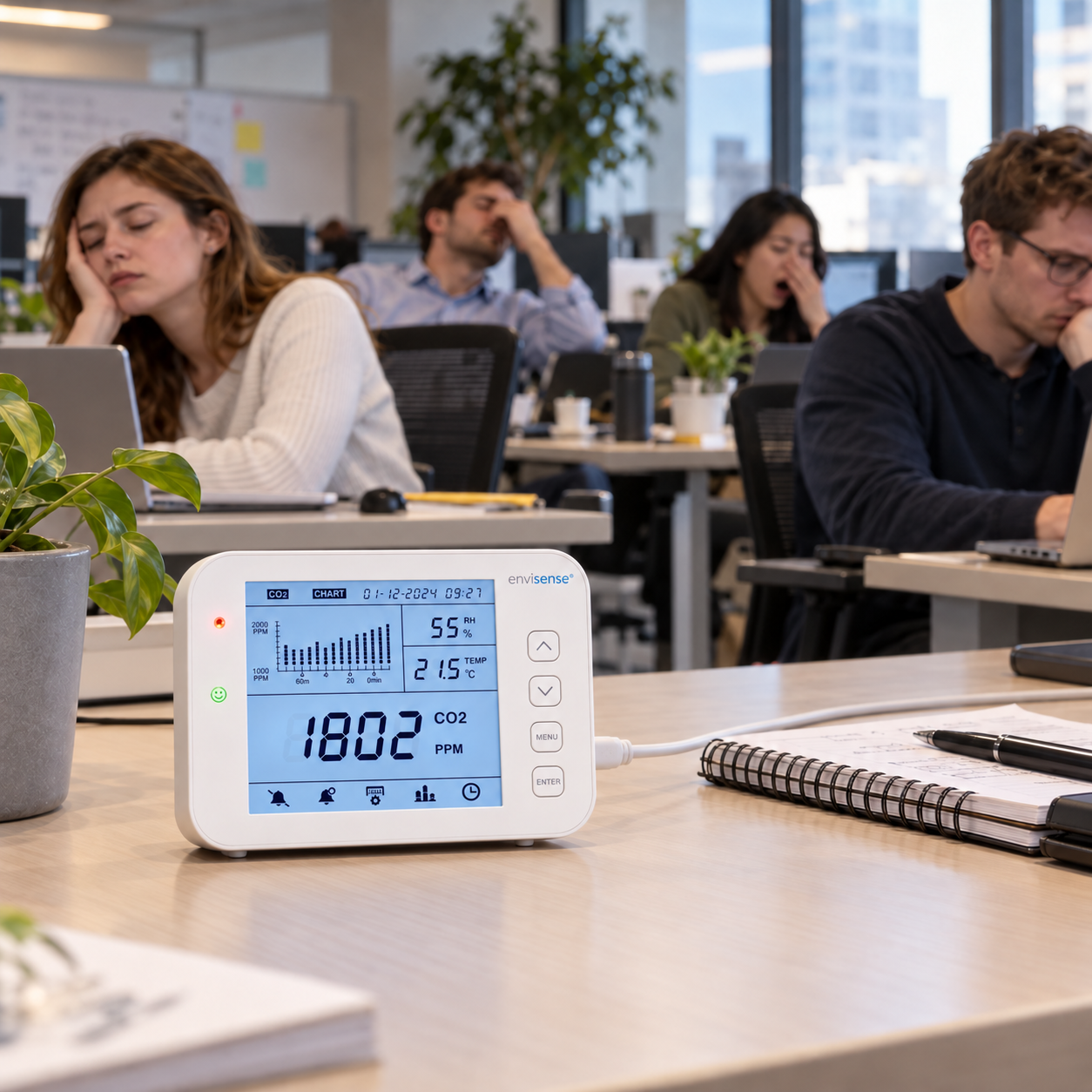
From a CO2 level of around 1000 to 1200 ppm, you may experience complaints that affect your daily life. You are less alert, sleep worse and get tired more quickly. This is not immediately dangerous, but it is unhealthy if it happens often or for long periods.
CO2 only becomes truly dangerous at much higher CO2 levels. In the workplace, a limit of 5000 ppm applies, averaged over an 8-hour working day. Above 40,000 ppm there is acute danger, such as shortness of breath and fainting. You won't encounter CO2 levels this high in an ordinary home. The complaints you experience at home are mainly caused by the CO2 level being too high for a long time.
Those 40,000 ppm are almost a hundred times as much as in outdoor air. That's why the CO2 level in a room rises so quickly when people are present and little fresh air comes in.
Not entirely. Where the CO2 level rises due to insufficient ventilation, moisture, odours and other air pollutants can also build up. Think, for example, of volatile organic compounds (VOCs) released from furniture, paint, cleaning products and air fresheners. A high CO2 level therefore acts as a warning signal: too little fresh air is coming in. So if you make sure enough fresh air does come in, you tackle all these substances in one go.
You solve this with one thing: fresh air. With the four steps below, you can bring the CO2 level down and keep it low.
Air out briefly and thoroughly
Open the windows on two sides of your home for 10 to 15 minutes a few times a day. This lets the air flow through quickly.
Ventilate all day long
Always keep the ventilation grilles above your windows open. Even at night and in winter.
Choose mechanical ventilation
A mechanical ventilation system automatically ensures a supply of fresh air, day and night.
Measuring is knowing!
A CO2 monitor uses colours to show when the CO2 level is getting too high. That way, you can take action straight away.

Opening windows on opposite sides works well, but it also has drawbacks. In winter, your home cools down quickly and your energy bill goes up. And at night, an open bedroom window isn't always pleasant when it's cold or there's a lot of noise outside. That's why more and more people are choosing a ventilation solution that always works. With a mechanical ventilation system a ventilation unit continuously extracts the stale air throughout your home. At the same time, fresh air comes in through the ventilation grilles.
Would you rather not lose any heat indoors? Then a heat recovery unit is a smart choice. This system extracts the heat from the indoor air going outside and then transfers that heat to the fresh outdoor air coming in. That way, you always have fresh and at the same time warm air indoors.
Is the CO2 level persistently too high in one room in particular, for example in the bedroom or your home office? Then a decentralised heat recovery unit is an easy, accessible solution. A decentralised heat recovery unit is fitted in the outside wall of that room and ventilates only that one room. Just like a central heat recovery unit, the device extracts the heat from the air going outside and transfers that heat to the fresh air coming in. The big advantage: you don't need a duct system throughout the whole house. Only an opening in the outside wall is needed, which makes installation much simpler and less disruptive.

Item number: 19100098
Item number: 19100096

Item number: 19100093

Item number: 19100090
A high CO2 level in your home often builds up unnoticed. Usually, you only notice it once you experience complaints. By airing out regularly, keeping ventilation grilles open and using a good ventilation system, you keep the air fresh, for yourself and for others. Not sure which solution suits your home best? Then contact our customer service! We're happy to help you find the right solution.
In the FAQ below, we've listed the most frequently asked questions about CO2 in the home and its effects on your health. Do you have specific questions about your situation, or can't quite figure it out? Our experts are ready to help!
In the home, a CO2 level between 400 and 800 ppm is normal and healthy. For comparison: outdoors, the CO2 level is around 420 ppm. Does the CO2 level occasionally come out a little higher, for example while cooking or when you have visitors? That's not a problem, as long as the CO2 level drops again afterwards.
At the CO2 levels you measure at home, CO2 is not immediately dangerous. However, from a CO2 level of around 1000 to 1200 ppm, you may experience complaints such as tiredness, headaches and poorer sleep. CO2 only becomes acutely dangerous at extremely high CO2 levels, far above anything found in a home.
CO2 (carbon dioxide) is something we breathe out ourselves. A high CO2 level is mainly a sign of poor ventilation. CO (carbon monoxide) is a completely different gas that is released during incomplete combustion, for example from a boiler, gas water heater or wood burner. CO is harmful even at low levels of a few dozen ppm and can be life-threatening. A CO2 monitor does not measure CO. Do you have a fuel-burning appliance at home? Then always fit a carbon monoxide alarm.
Try to keep the CO2 level in the bedroom below 1000 ppm at night, and preferably below 800 ppm. Because you spend a long time there in one go with the door closed, the CO2 level in the bedroom rises faster than in the rest of the house. An open ventilation grille, a door left ajar or mechanical ventilation helps keep the CO2 level low.
First, open windows on two sides of the house so fresh air comes in quickly. Then make sure your home is ventilated all day, with open ventilation grilles and a ventilation system on the right setting. Is the CO2 level often too high? Then mechanical ventilation or a heat recovery unit is a permanent solution.
At Ventilationland, we think it is important that we can always be reached and answer your questions as quickly as possible. Therefore, you can reach us in several ways, including via chat or WhatsApp. We are happy to help!