

All you need to know about bathroom extraction systems

A bathroom extractor fan is an exhaust fan specifically designed for moist areas such as bathrooms and/or toilets. The bathroom extractor fan, also referred to as bathroom extraction, helps effectively remove moisture from the room. This regulates the humidity level and prevents issues such as unpleasant odours and mould formation.
How much extraction capacity does my bathroom extractor fan need?
The extraction capacity of a bathroom extractor fan is crucial for preventing unpleasant odours and mould formation. To calculate the required extraction capacity, you need to look at the cubic volume (m³) of the bathroom where the bathroom extractor fan will be installed. Use the formula Length × Width × Height. As a general rule, the outcome should be multiplied by 10 to arrive at the required extraction capacity.
Example: If your bathroom is 3 metres long, 2 metres wide, and 2.5 metres high, the required capacity is: 3 × 2 × 2.5 × 10 = 150 m³/h. The number 10 represents the number of air changes per hour (ACH) that a bathroom typically needs.
If your home already has a ventilation system, such as mechanical ventilation or an MVHR system, the bathroom extraction should be connected to that system. If the distance between the wall outlet or roof outlet and the extraction point in your bathroom is greater than 1.5 metres, an inline duct fan is the best choice. See the chapter ”How do I choose the right bathroom extractor fan?” for details on available options and considerations.
Bathroom extraction capacity calculator
Calculate the amount of bathroom extraction you need (m³/h), based on Lenght × Width × Height × factor.
What if my bathroom extractor fan has too little capacity?
If your bathroom extractor fan has too little capacity, it will struggle to remove moisture effectively. As a result, moisture will remain in the room for longer, leading to a damp environment (for example, condensation on mirrors, moist walls, or damp objects). This can also cause unpleasant odours. In cases of insufficient extraction or inadequate ventilation capacity, mould growth and damage to interior elements (such as wood rot or peeling plaster) can occur.
What if the extraction capacity of my bathroom extractor fan is too high?
A bathroom extractor fan with too high a capacity is less harmful than one with insufficient capacity, but it is still not ideal. Excessive extraction can cause the air to be removed too quickly, resulting in draughts or reduced comfort. It also leads to unnecessary energy consumption, which can increase your energy bill. In addition, an overly powerful bathroom extractor fan may produce (too) much noise, making it less pleasant to use.
The importance of good air supply
The purpose of a bathroom extractor fan is to actively remove moist and polluted air from the bathroom and exhaust it outdoors. However, a bathroom extractor fan does not regulate the air supply in the bathroom. Make sure there is sufficient fresh air entering the bathroom, for example through window vents, door grilles, a gap under the door, or a decentralised MVHR unit. This ensures that enough fresh air can enter the bathroom to replace the extracted air. Without sufficient air supply, negative pressure can build up in the bathroom extractor system, reducing its effectiveness.
Eisen en regelgeving
In het Besluit bouwwerken leefomgeving (Bbl) staat de minimale ventilatiecapaciteit vastgelegd. Dit is:
- Toiletten: minimaal 25,2 m³/h (gelijk aan 7 dm³/s).
- Badkamers: mimimaal 50,4 m³/h (gelijk aan 14 dm³/s).
Voor badkamers zijn ongeveer 6 volledige luchtverversingen per uur nodig om schimmels tegen te gaan. Voor het toilet ligt dit aantal iets lager, maar focust de afzuiging zich met name op het snel afvoeren van vieze luchtjes. Nieuwbouwwoningen zijn verplicht om aan de minimale capaciteit van 50,4m³/h te voldoen. Voor bestaande woningen is dit pas nodig bij een grote verbouwing of renovatie. Blijft deze verbouwing of renovatie uit? Dan blijven de 'oude' ventilatie-eisen (uit het Bouwbesluit) van het bouwjaar gelden.
Toch adviseren wij iedereen om de huidige Bbl-eisen aan te houden. Dit helpt namelijk om schimmel en nare geurtjes nog beter tegengaan. Zo behoud je een gezonder en fijner binnenklimaat in jouw badkamer of toilet. Meer informatie de wettelijke ventilatie-eisen vind je op de informatieve pagina’s van het IPLO (Informatiepunt Leeromgeving van de Rijksoverheid). Zie hiervoor de pagina's over de ventilatie-eisen van luchtverversing voor nieuwbouw en bestaande bouw.

How do I choose the right bathroom extractor fan?
Choosing the right bathroom extractor fan can be challenging, especially considering the different possibilities and options available. The most important factor is ensuring that the extraction capacity is sufficient (Length × Width × Height × 10 = required m³/h), as explained in the chapter How much extraction capacity does my bathroom extractor fan need?
Placement and available ventilation systems
The bathroom extractor fan you need depends partly on where it will be installed and whether a ventilation system is already active in the home.The distance between the bathroom extractor fan and the roof outlet or wall outlet also plays an important role. Below, we explain the different situations and suitable solutions. Always ensure that the extraction capacity is sufficient to ventilate the space effectively.
Mechanical ventilation or MVHR system available
If your home already has a mechanical ventilation system or an MVHR unit, you do not need a separate bathroom extractor fan. These systems already provide sufficient extraction in the bathroom. Installing an additional bathroom extractor fan alongside these systems is not recommended, because:
- With MVHR: It disrupts the balance ventilation system. Supply and extraction become unequal, reducing heat recovery efficiency and negatively affecting indoor air quality.
- With mechanical ventilation: The bathroom extractor fan adds too much extraction, causing dry air, draughts, higher energy consumption, and reduced comfort.
If you still choose to install a bathroom extractor fan together with mechanical ventilation, make sure the bathroom extraction duct of the mechanical system is sealed airtight. The bathroom extractor fan will then handle the full extraction of the bathroom. Also ensure the extraction capacity is sufficient for effective ventilation. For MVHR systems, the extraction duct in the bathroom should never be sealed, as this would unbalance the entire system.
To neatly finish the bathroom extraction point, you can install a ceiling grille, plaster-in vent, or an extraction valve. Clean these regularly to maintain optimal performance. More information on cleaning and maintenance can be found in the section "How do I maintain my bathroom extraction system?”
Homes without a ventilation system and with an extraction point less than 1.5 metres away
If your home does not have a ventilation system and the extraction point is located less than 1.5 metres from the bathroom (or if you plan to place it there), choose a bathroom extractor fan. The bathroom extractor fan can be installed directly in or on the wall. Choose a suitable wall outlet or roof outlet so moisture can be properly expelled outdoors. Keep the ducts as straight as possible to minimize resistance (pressure loss). Bends, folds, or sharp angles reduce airflow efficiency. Ventilation grilles, valves, or wall/roof outlets also create light resistance. The product specifications indicate how much extraction capacity the fan delivers under various pressure levels.
Note: A bathroom extractor fan only removes moist air; it does not bring in fresh air. If your bathroom has no window, window vent, door grille, or door gap — and fresh air cannot enter in any other way — but the bathroom is adjacent to an exterior wall, choose a decentralised MVHR unit. This provides both extraction and fresh air supply.
Homes without a ventilation system and with an extraction point more than 1.5 metres away
If the distance between the bathroom and the wall or roof outlet is more than 1.5 metres and there is no ventilation system in the home, a standard bathroom extractor fan will not be sufficient to remove moist air effectively. In this situation, a bathroom extractor fan often lacks the necessary extraction capacity due to pressure loss along the duct. The best solution would be an inline duct fan. Install the duct fan inside the ventilation duct that is directly connected to the wall or roof outlet. When choosing the right inline duct fan, make sure the extraction capacity matches the needs of your bathroom
If the duct contains bends or branches, keep in mind that these create resistance and reduce extraction performance. Product specifications for each model indicate how much airflow the fan can deliver at specific pressure levels.
Note: An inline duct fan must always meet the minimum extraction requirements for effective bathroom ventilation. Smart inline duct fans with features such as a timer or humidity sensor are available if you prefer additional automation. Inline duct fans must never be integrated into mechanical ventilation or MVHR ducts, as this disrupts system balance and reduces effectiveness.
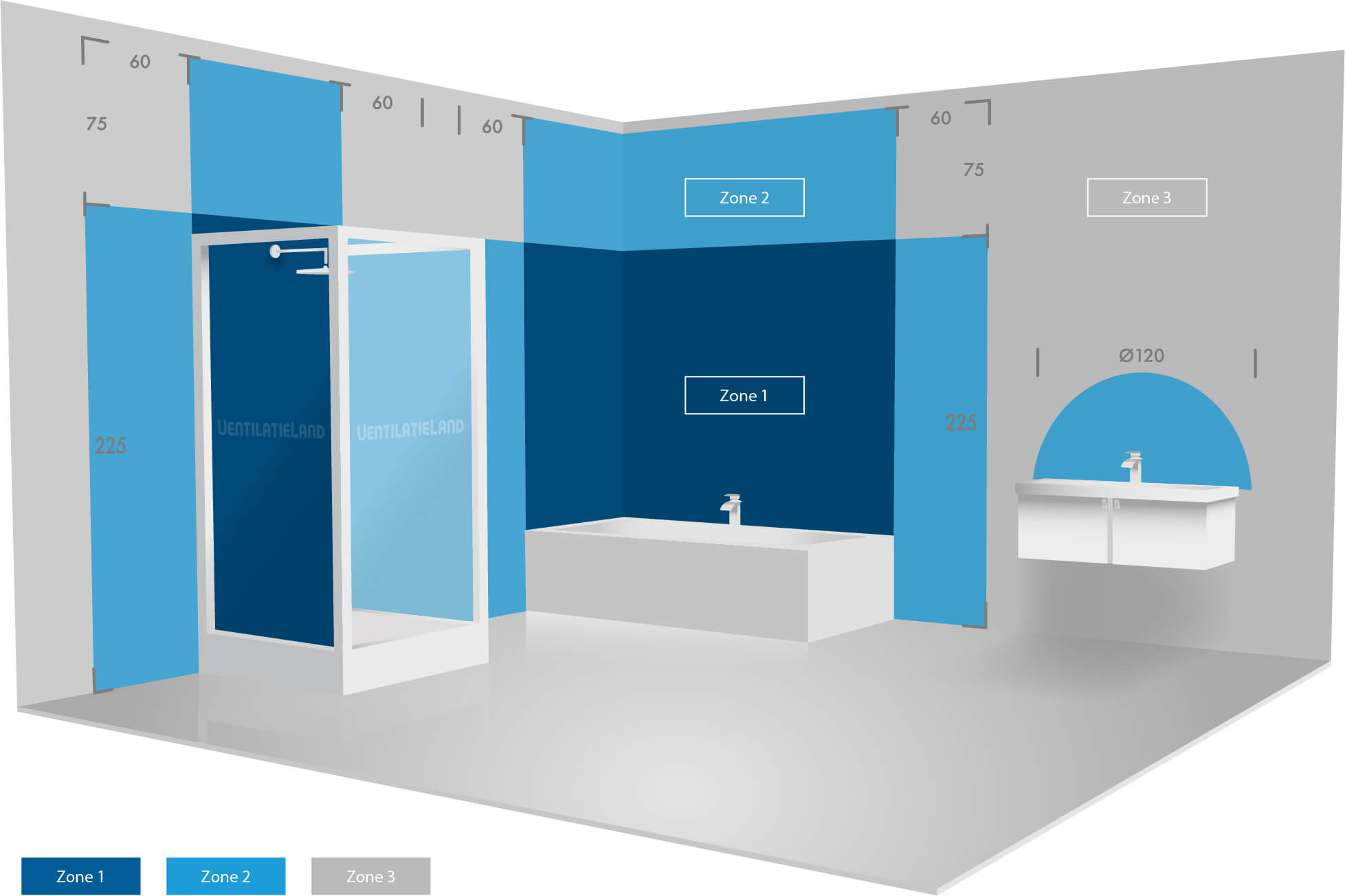
Installation zones and IP ratings
The installation zone of a bathroom extractor fan determines the minimum required IP rating. The IP rating (Ingress Protection) indicates how well the device is protected against solid objects (first digit) and water (second digit). The higher the number, the better the protection.
- Zone 0: This zone is located inside the bath or shower tray. A bathroom extractor fan in this zone may be exposed to direct and prolonged water contact, including the risk of submersion. Only bathroom extractor fans with a minimum rating of IPX7 and a SELV (Safety Extra-Low Voltage) supply of up to 12 volts bathroom extractor fans may be installed here.
- Zone 1: This zone is located directly above the bath or shower up to a height of 2.25 metres. A minimum of IPX4 is required. Although SELV (12V) bathroom extractor fans are recommended, 230V fans are allowed if they are connected to a 30mA RCD (Residual Current Device) and meet the correct IP rating.
- Zone 2: This zone extends 0.6 metres outside zone 1 and up to 2.25 metres in height. Contact with splashing water is possible. IPX4 is recommended. 230V devices may be installed here..
- Zone 3: This is any bathroom area outside zones 0, 1, and 2, where the risk of water contact is low. A minimum of IPX1 is permitted, although IPX4 is recommended for additional safety.
Placement tipPlace the bathroom extractor fan as far away as possible from the source of fresh air (for example, a door gap, door grille, openable window, or window vent). This prevents fresh air from being extracted immediately, improving overall airflow and reducing condensation more quickly.
Sensors and controls
Bathroom extractor fans, as well as other ventilation solutions such as inline duct fans, decentralised MVHR units, and central ventilation systems, can often be combined with sensors and controls. Some models even have these features built in. Various sensors and control options can make your bathroom extractor system more comfortable and efficient:
Humidity sensor (hygrostat)
Most ventilation systems and bathroom extractor fans either come with a humidity sensor or can be equipped with one. The humidity sensor measures the relative humidity (RH) and decides when the fan should turn on, off, or adjust its speed. This saves energy and prevents the fan from activating too early or too late. The RH threshold is often adjustable so you can tailor it to the size of your bathroom or the season. Since humidity in a bathroom can reach 80–100% during showering, and mould tends to develop at levels above 70%, it is recommended to set the threshold around 65–70%. This ensures that moist air is extracted quickly until the bathroom returns to a healthy RH level.
Timer
A bathroom extractor fan with a timer is usually connected to the power supply and the light switch. When the switch is turned on, the fan starts automatically. When the switch is turned off, the fan continues running for several minutes. The duration can often be adjusted using a control knob, panel, or app. It is recommended to let the fan run for at least 15–20 minutes after showering to remove moisture and odours effectively.
Motion sensor (PIR)
Bathroom extractor fans with a motion sensor detect when someone enters the room and can activate automatically, even if the lights remain off. This is useful in bathrooms with natural daylight where lighting is not always needed. These fans often also include a humidity sensor and/or timer, ensuring the fan continues running even when no movement is detected (for example, when showering and standing outside the sensor’s field of view).
Combination of humidity sensor and timer
Some bathroom extractor fans offered by Ventilationland are equipped with both a humidity sensor and a timer. This is a highly effective combination: the fan activates either when the switch is turned on or when humidity rises above the threshold. The humidity sensor continues to monitor moisture levels even while the fan is running during the timer period. Once the humidity has dropped to a healthy level, the sensor can reduce the fan speed or turn it off entirely—overriding the timer for improved energy efficiency.
Inline duct fans are also available with humidity sensors and timers, making them a convenient choice for bathrooms where an inline fan is the better solution.
Energy-efficient fans
When looking at sustainability and energy efficiency, it is important to consider the type of motor used in the bathroom extractor fan. Fans with an AC motor typically consume around 15 to 30 watts per hour based on a fan with an extraction capacity of 100 m³/h. Fans equipped with a DC/EC motor consume significantly less, usually between 2 and 8 watts per hour at the same airflow capacity. This makes a bathroom extractor fan with a DC/EC motor not only more energy-efficient but also more cost-effective over time. In addition, these motors are more future proof if new regulations or requirements related to energy consumption are introduced.
Technical considerations and the best choice for your bathroom
Connecting a bathroom extractor fan to the electrical system, especially when sensors are involved, can be challenging if you do not have experience with electrical installations. In that case, you may prefer to have the fan installed by a professional. Alternatively, you can choose one of Ventilationland’s convenient plug and play bathroom extractor fans. These fans are equipped with a power plug and pull cord, making installation and use much easier. More information about installing a bathroom extractor fan can be found in the section How do I install a bathroom extractor fan? If an inline duct fan is more suitable for your bathroom setup, keep in mind that it must be wired directly into the electrical system
Noise levels
The noise level of your bathroom extractor system may not be the first thing you consider, but it is an important factor. Many people find a noisy extractor unpleasant. In general, the more powerful the fan (m³/h), the more noise it produces. Other factors can also influence noise levels, such as:
- Motor type: Fans with a DC/EC motor are not only more energy efficient and durable but also quieter than fans with an AC motor.
- Maintenance: Dust and dirt buildup inside the fan can increase noise. Regular cleaning helps to keep the fan quiet. See the section How do I maintain my bathroom extractor system for more information.
- Ventilation ducts: Narrow ducts or ducts with many bends, folds, or corners increase resistance. The fan must work harder, resulting in more noise (dB).
- Vibration dampers or loose components: Incorrect installation or missing vibration dampers can cause unwanted noise, especially when mounted directly on a hard surface such as a wall or beam.
Product specifications always indicate the noise level of each bathroom extractor fan. Keep in mind that the factors listed above may influence actual noise levels in your bathroom.
Costs of a bathroom extractor fan?
The cost of a bathroom extractor fan can range from a few tens to several hundred euros. The price difference can be influenced by various factors, such as:
- The brand and model;
- The materials used;
- The extraction capacity;
- The noise level (dB);
- Built-in features such as a humidity sensor, motion sensor, or timer;
- The type of motor (AC vs. DC/EC);
- The IP rating (protection against water);
- The design and appearance;
- Etc.
Bathroom extractor fans with a DC/EC motor are generally more expensive than models with an AC motor, but this is compensated by long-term energy savings. They are also less sensitive to future changes in energy or ventilation requirements.
By investing in a higher-quality bathroom extractor fan — not necessarily the most expensive, but a technical upgrade — you also help reduce potential future maintenance costs, such as issues caused by insufficient ventilation.
In addition to the fan itself, you may need to consider installation materials, such as ventilation ducts (flexible hose), wall or roof outlets, vibration dampers, and duct insulation. These materials may be necessary if you are installing or upgrading a complete bathroom extractor system
Which bathroom extractor fans does Ventilationland offer?
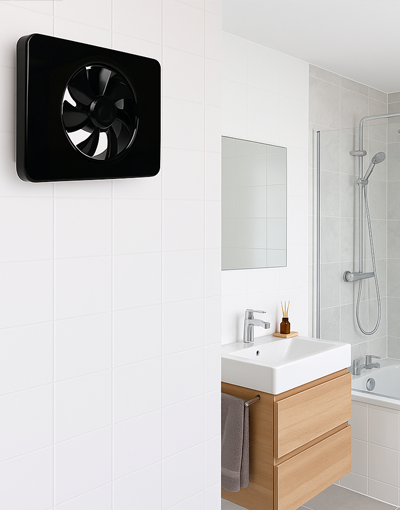
Ventilationland offers a wide range of bathroom extractor fans, including models from well-known brands such as Vent-Axia and Itho Daalderop. The selection includes square and round bathroom extractor fans, simple or luxury designs, surface-mounted or recessed models, and various colours to match your interior. You can also choose fans with a timer, humidity sensor, motion sensor, or pull cord and plug for added convenience.If you prefer a quiet bathroom extractor fan or require a particularly powerful bathroom extractor fan, Ventilationland has suitable options for every situation.
All bathroom extractor fans come in connection diameters of 100 mm, 120 mm, 125 mm, or 150 mm. Most models are suitable for wall installation, except for ceiling-mounted bathroom extractor fans. If you need help choosing, consider looking at the best-selling models or using the filter options on the bathroom extractor fans overview page.
Inline fans, ventilation grilles, and alternatives
If a bathroom extractor fan is not the ideal solution for your situation, an inline duct fan may be more suitable. Ventilationland offers a wide range of inline fans in various sizes and with different features and sensors. If your home already has a ventilation system that manages bathroom extraction, you may instead require ventilation grilles, extraction valves or plaster-in vents to finish the extraction point neatly.
How long does a bathroom extractor fan last?
A bathroom extractor fan that runs for an average of 2 to 3 hours per day typically lasts between 40 and 50 years. A fan that runs 24 hours a day will generally last around 5 to 6 years. The lifespan also depends on factors such as maintenance, motor type, the age of the fan, and the overall build quality.More information on cleaning and maintaining your bathroom extractor fan can be found in the section "How do I maintain my bathroom extractor system? Proper maintenance ensures optimal performance and a longer lifespan.
Alternatives to bathroom extractor fans?
Factors such as the length of the ventilation duct and the presence of (active) mechanical ventilation or heat recovery ventilation are decisive in determining whether a bathroom fan is the right solution. Is there a ventilation system? Then connect the bathroom extractor system to it. Is the exhaust duct longer than 1.5 meters? Then choose a inline duct fan.
But what if your home doesn't have a ventilation system and it's not possible to install an exhaust duct/extractor in your bathroom? Fortunately, there are other alternatives, such as:
- Natural ventilation: Opening a window can help ventilate your bathroom. However, if condensation remains on the window after showering, this indicates insufficient natural ventilation. In such cases, consider a window extractor fan or a natural wall vent to increase airflow.
- Window or wall fans: A window extractor fan can be an effective addition to bathroom ventilation, provided that a window is available. If there is no window, a wall-mounted bathroom extractor fan may be installed (directly through an exterior wall). Window and wall fans can also include features such as a humidity sensor, light sensor, timer, or motion sensor.
- Portable dehumidifier: A mobile dehumidifier extracts moisture from the air, condenses it, and stores it in a water tank. Once the tank is full, it must be emptied (or drained via a hose, depending on the model). This can be useful in bathrooms where installing a fan is not an option. Note that portable dehumidifiers can be relatively large and take up space, especially in smaller bathrooms.
- Decentralised MVHR unit:If your bathroom lacks sufficient air supply and no practical options are available to improve it, but the bathroom is adjacent to an exterior wall, a decentralised MVHR unit may be the best solution. This device provides both extraction and fresh air supply through a reversible motor.
- Moisture-absorbing plants: Certain plants, such as ferns, peace lilies, aloe vera, and tillandsia, can help reduce humidity by absorbing moisture from the air. These plants tolerate the temperature fluctuations common in bathrooms. However, they are not a replacement for a bathroom extractor system.
Note: These plants are not a replacement for bathroom extraction in any sort. These plants help to lower the humidity level, but are not suitable to ventilate a bathroom.

How do I install my bathroom extractor fan?
In most cases, you can install a bathroom extractor fan yourself, provided you know what you are doing. Always begin by checking whether the fan has sufficient extraction capacity and whether it has the correct connection diameter to ventilate the bathroom effectively. Our guide “Installing a bathroom extractor fan yourself” explains step-by-step how to connect the fan, which tools you may need, and what to look out for.
If you do not have the technical knowledge to connect a fan to the electrical system, but you do have a free power socket and want a quick installation, choose a bathroom extractor fan with a plug. The installation manuals can be found in the product attachments.
How do I maintain my bathroom extractor fan?
Maintaining a bathroom extractor fan is not difficult, but it must be done regularly. We recommend cleaning the exterior and cover of the fan every 3 to 6 months. This reduces the buildup of dust and dirt that can accumulate behind the cover and inside the fan. We also recommend thoroughly cleaning the fan blades at least once a year. Removing dust and dirt ensures the blades do not have to work as hard to reach the required extraction capacity, resulting in better performance.
Additionally, monitor the fan’s performance. Increased noise or reduced extraction efficiency may indicate that maintenance or cleaning is required. If the fan activates too late, does not run long enough, or responds slowly to the switch, this may be related to humidity sensor settings or the electrical connection. In such cases, check the sensor settings and ensure the fan is properly connected to the power supply.
Ventilationland, your expert in bathroom extraction solutions
Ventilationland offers a wide selection of bathroom extractor fans, toilet fans, and shower extractors. All products come with the lowest price guarantee. If you have questions or need assistance choosing the right bathroom extractor fan, you can consult our instructional videos and ventilation blogs. If you prefer personal advice, feel free to contact our specialists for free technical support.

FAQ
We hope all your questions have been answered within this article. Have you not found your question or solution? Feel free to contact us at [email protected], by chat or via Whatsapp.